Fun Ways to Learn Multiplication: 10 Activities Beyond Worksheets
Ten fun ways to learn multiplication at home or in class: array art, hopscotch, a pretend shop, scavenger hunts, songs, personal-best challenges and more.
Print, check and practice
Start with a worksheet and its answer key, or follow the five-day pack. Both are free and available in Letter and A4.
Learning the times tables takes a lot of repetition, and repetition does not have to be dull. The activities below give children the same practice as a worksheet, but through drawing, moving, shopping, singing and setting their own records. Most need nothing more than paper, chalk or a few household objects, and each one works at home or in a classroom.
What You'll Learn
- Ten activities that make multiplication practice fun
- Which ones build understanding and which ones build speed
- How to choose activities for ages 6 to 11
- How to keep fun practice effective
Why Fun Practice Helps
Children remember facts they meet often, in short sessions spread over many days. The hard part is getting them to come back to practice every day. When practice is enjoyable, children ask for it, sessions run longer without complaint, and mistakes feel like part of the game rather than failure. Fun is not the goal in itself; it is what makes daily practice happen.
For card, dice and board games, see our guide to multiplication games for kids. This article covers the other ideas: art, movement, role play, music and challenges.
10 Fun Ways to Learn Multiplication
1. Array Art
Give children grid paper and stickers, stamps or colored pencils. To show 4 × 6, they draw 4 rows of 6 stars and count 24. Then they turn the paper sideways to see 6 rows of 4, the same 24. Array art builds the meaning of multiplication and shows the turnaround rule (4 × 6 = 6 × 4) without a single explanation. A wall of arrays for one table makes a colorful classroom display.
2. Multiplication Hopscotch
Chalk a hopscotch grid with the multiples of one table: 3, 6, 9, 12 and so on. Children hop up the grid saying each multiple aloud, then hop back down. Next, call a fact ("3 × 7") and they jump straight to 21. Indoors, use paper squares taped to the floor. Movement helps active children stay focused, and saying the sequence aloud reinforces skip counting.
3. Building Blocks
Use interlocking bricks or cubes to build towers of equal height: five towers of three bricks show 5 × 3. Children can then push towers together into a rectangle to make an array. Building is especially useful for younger children who are still learning that multiplication means equal groups. Our article on teaching multiplication with manipulatives has more ideas.
4. A Pretend Shop or Café
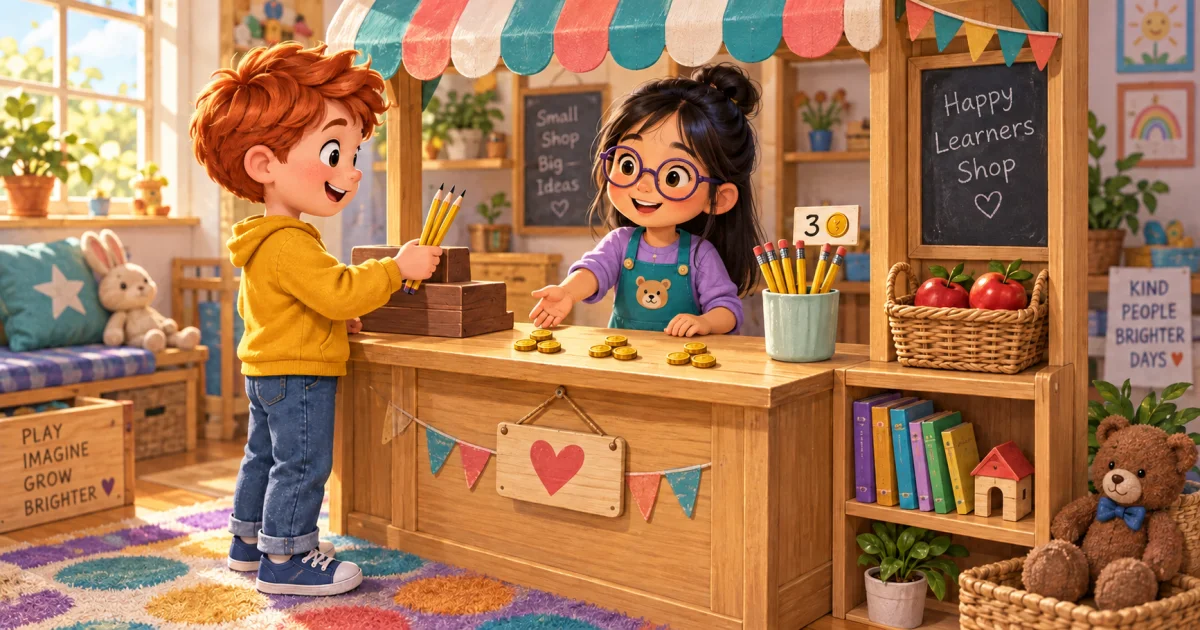
Set up a shop with simple prices: pencils cost 3 coins, apples 4 coins, books 7 coins. Customers buy several of the same item ("five apples, please") and the shopkeeper works out the bill. Swap roles often. Children practice multiplication in a real situation, which is exactly what word problems ask them to do later.
5. Scavenger Hunt
Hide cards around the room or home. Each card has a fact, and the answer leads to the next clue: "7 × 8 = ?" sends the child to the book on page 56, or to the drawer labeled 56. The last card holds a small reward or a final challenge. Scavenger hunts are perfect for a rainy afternoon or the last lesson before a holiday.
6. Songs and Skip-Counting Chants
Singing the multiples of a table to a familiar tune makes a sequence easy to remember, and children enjoy making up their own verses. Songs work best for learning the order of multiples; follow them with mixed-order practice so children can find 7 × 6 without singing from the start. Our skip-counting songs and times tables songs articles list tunes for every table.
7. Pattern Hunting
Print a multiplication chart and ask children to color all the multiples of 9. What do they notice? From 9 × 1 to 9 × 10, the tens digit goes up by one while the ones digit goes down by one, and the digits add up to 9. Coloring the 5s, the 2s or the square numbers shows other patterns. Patterns turn memorizing into discovering, and they give children a way to check their answers. See multiplication patterns for a full list.
8. Story Problems About Their Own Interests
Write problems around what the child loves: "Your football team has 4 practice sessions a week for 6 weeks. How many sessions is that?" or "Each dragon has 4 legs. How many legs do 9 dragons have?" Better still, ask children to write problems for each other. Making up a problem shows that they understand when multiplication applies.
9. Personal-Best Challenges
Children love beating a record, especially their own. A one-minute times tables speed test gives a score they can try to improve each day, without comparing them to anyone else. Keep a simple chart of daily scores so progress is visible. Before the speed test, a short session in practice mode lets them warm up on one table with hints.
10. Teach It on Video
Older children can record a short video explaining a trick, such as the finger trick for the 9s or doubling the 4s to get the 8s. To explain a strategy clearly, they have to understand it well. Watching each other's videos also gives the class a library of tips in their own words. Our multiplication tricks article is a good source of ideas.
Choosing Activities by Age
- Ages 6 to 8: blocks, array art, songs and hopscotch build the idea of equal groups and the 2s, 5s and 10s.
- Ages 8 to 9: the pretend shop, pattern hunting and scavenger hunts cover the 3s, 4s, 6s and 8s and connect facts to real situations.
- Ages 9 to 11: personal-best challenges, story problems and teaching videos build speed with the harder facts and the 11s and 12s.
Keeping Fun Practice Effective
Fun works when children still answer many facts. A beautiful array poster that took an hour but covered only four facts is a good start, not a full practice session. Pair a creative activity with a few minutes of quick recall, for example array art followed by a one-minute challenge on the same table.
Short and often beats long and rare: ten minutes a day does more than an hour on Sunday. Focus on one or two tables at a time, and come back to earlier tables every few days so they are not forgotten.
Frequently Asked Questions
They can, as long as the activity includes plenty of facts to recall. Choose activities where children answer many problems, and keep some written or timed practice so you can see their progress.
Ten to fifteen minutes is enough for most children. Younger children may need even shorter sessions. Regular daily practice matters more than long sessions.
Start with something that builds understanding, such as blocks or array art, then add a song for the table you are learning. Once the facts make sense, move on to scavenger hunts and personal-best challenges for speed.
Try It Today
Print a chart for pattern hunting, then set a first personal best with a one-minute speed test.