How to Memorize Multiplication Tables Fast: 10 Techniques
10 practical ways to memorize multiplication tables: smart learning order, patterns, finger tricks, rhymes, spaced practice, games, and a sample 8-week plan.
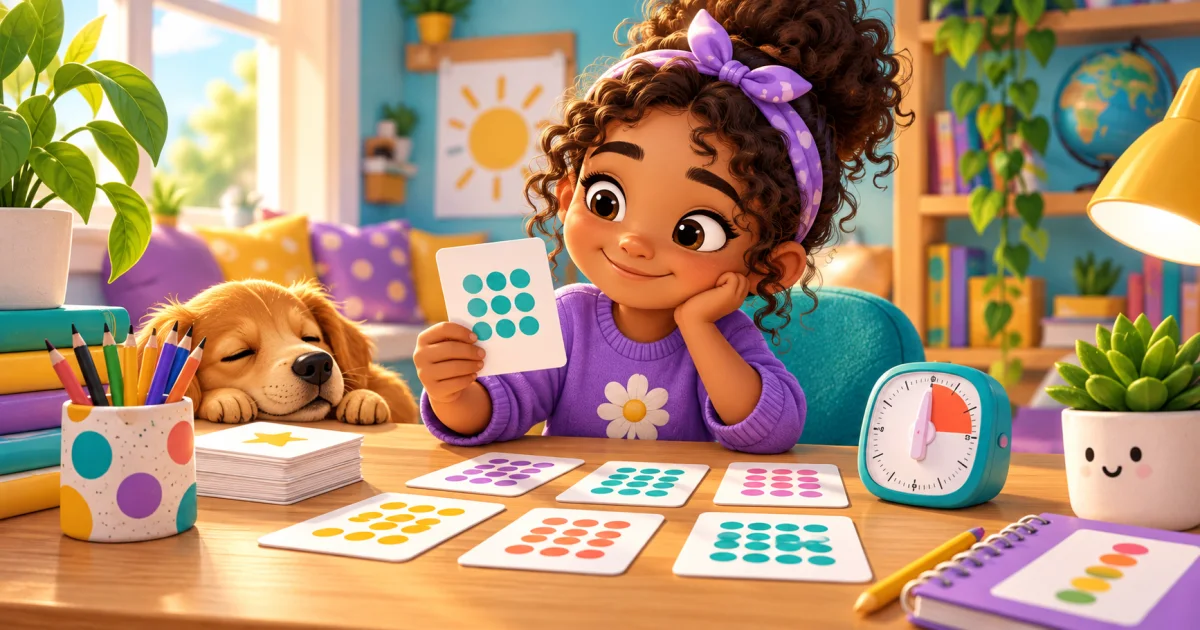
Print, check and practice
Start with a worksheet and its answer key, or follow the five-day pack. Both are free and available in Letter and A4.
Memorizing multiplication tables is one of the most important mathematical milestones in elementary education, yet it often feels overwhelming for students and parents alike. The good news is that with the right techniques, memorizing times tables can be faster, easier, and even enjoyable. This guide presents 10 practical methods, several of them grounded in well-established learning research such as spaced and retrieval practice, that help children build multiplication fluency step by step.
What You'll Learn in this Guide
- 10 practical memorization techniques
- How to combine methods to suit each child
- Realistic timelines for multiplication mastery
- Step-by-step implementation strategies
- How to maintain long-term retention
Why These Techniques Work
Before diving into specific methods, it's important to understand why certain memorization approaches succeed while others fail. Effective multiplication learning combines three essential elements: understanding the concept, recognizing patterns, and building automatic recall through practice.
Traditional rote memorization (simply repeating facts over and over) is the least efficient method because it relies on a single learning pathway. The techniques presented here give children several ways into each fact: seeing patterns, hearing rhythms, using their hands, and connecting facts to things they already know. The more connections a fact has, the more ways there are to retrieve it.
Research in cognitive science consistently finds that spaced repetition, active recall, and meaningful connections produce better long-term retention compared to massed practice and passive review. The methods below incorporate these evidence-based principles.
Technique 1: Strategic Sequencing
Not all multiplication tables are equally difficult. Learning them in strategic order rather than sequential order (1, 2, 3, 4...) dramatically accelerates progress and builds confidence.
The Optimal Learning Sequence
Phase 1: Easy Wins (Week 1)
Start with the easiest tables to build confidence and momentum.
- 1x table: Any number times one equals itself
- 10x table: Simply add a zero to the number
- 11x table: Repeat the digit (up to 9)
- 2x table: Doubling, which most students know from basic addition
After just one week, students have mastered four complete tables, approximately one-third of all facts.
Phase 2: Skip Counting Foundation (Week 2)
Build on counting skills students already possess.
- 5x table: Count by fives, connecting to clock and money
- 9x table: Finger trick and digit patterns make this easier than it appears
Phase 3: Building Relationships (Weeks 3-4)
Use known facts to derive new facts.
- 4x table: Double the 2x facts
- 3x table: One more group than 2x facts
- 6x table: Double the 3x facts or combine 5x plus 1x
Phase 4: The Challenges (Weeks 5-7)
Tackle the genuinely difficult tables with concentrated effort.
- 7x table: Requires memorization, songs, and tricks
- 8x table: Double the 4x facts, patterns, and practice
Phase 5: Extension (Week 8)
- 12x table: Practical applications and patterns
This strategic sequence ensures constant progress and prevents the discouragement that comes from starting with difficult tables.
Related: easy way to learn times tables
Technique 2: Commutative Property Shortcut
Understanding that multiplication is commutative (3×7 gives the same answer as 7×3) immediately cuts the memorization load nearly in half.
The Math Behind It
A complete 12×12 multiplication table contains 144 facts. However, due to the commutative property, there are only 78 unique facts to learn. The rest are simply the same facts reversed.
Implementation strategy:
- Teach the commutative property explicitly with manipulatives
- On a blank multiplication chart, have students cross out duplicate facts
- Visually demonstrate that learning 6×8 means you automatically know 8×6
- Practice saying both versions of each fact: "6 times 8 is 48, and 8 times 6 is also 48"
Students often feel immediate relief when they realize the learning task is half the size they imagined.
Confidence Building
Beyond reducing workload, understanding commutativity builds mathematical confidence. Students realize that if they can't remember 7×6 but can remember 6×7, they still have the answer. This fallback option reduces anxiety during tests and real-world application.
Technique 3: Visual Pattern Recognition
Multiplication tables are filled with beautiful patterns. Teaching students to recognize these patterns transforms abstract numbers into predictable, logical sequences.
Key Patterns to Teach
The 9x Digit Pattern: Products in the 9x table have digits that sum to 9 (or 18 for higher facts).
- 9×2=18 (1+8=9)
- 9×5=45 (4+5=9)
- 9×8=72 (7+2=9)
The tens digit increases by one while the ones digit decreases by one: 09, 18, 27, 36, 45, 54, 63, 72, 81, 90.
The 5x Ending Pattern: All products in the 5x table end in either 0 or 5, alternating between them.
Even Table Patterns: All products in even tables (2x, 4x, 6x, 8x, 10x, 12x) are even numbers.
Square Numbers: The diagonal of a multiplication chart shows square numbers (1, 4, 9, 16, 25, 36, 49, 64, 81, 100, 121, 144), which have their own pattern of growth.
Symmetry: The chart is perfectly symmetrical across the diagonal, visually demonstrating commutativity.
Teaching students to discover these patterns themselves through color-coding or exploration creates deeper understanding than simply telling them the patterns exist.
Related: multiplication patterns
Technique 4: The Finger Trick for 9x Table
The 9 times table finger trick is a kinesthetic method that provides a foolproof way to calculate any 9x fact using just your hands.
Step-by-Step Instructions
- Hold both hands in front of you, palms facing you, fingers spread
- Number your fingers from left to right: left pinky is 1, left ring finger is 2, continuing to right pinky as 10
- To calculate 9×n, fold down the finger corresponding to n
- Count fingers to the left of the folded finger (tens place)
- Count fingers to the right of the folded finger (ones place)
Example: 9×7
- Fold down the 7th finger (right index finger)
- Fingers to the left: 6 (tens place)
- Fingers to the right: 3 (ones place)
- Answer: 63
This method works for 9×1 through 9×10 and never fails. Students love the magic of having the answer literally at their fingertips.
Why It Works
The finger trick is actually a visual representation of the 9x digit pattern. The number of tens always equals one less than the number being multiplied by 9, and the ones digit completes the sum to 9. This hands-on method gives children a confidence-building backup strategy.
Related: 9 times table tricks
Technique 5: Rhythmic Chanting and Songs
Many children, especially younger ones, enjoy musical and rhythmic approaches to multiplication.
Creating Effective Chants
Multiplication chants work best when they have rhythm, rhyme, and repetition.
Example chants:
- "5, 10, 15, 20, 25, counting by fives, we're off and alive!"
- "2, 4, 6, 8, learning 2s is really great!"
- "Seven times seven is forty-nine, count by sevens and you'll be fine!"
The rhythm creates a mental "hook" that makes recall easier. Many students find they can hear the chant in their heads during tests.
Using Multiplication Songs
Numerous multiplication songs are available online, set to familiar tunes that students already know. The melody provides a retrieval cue.
Song implementation:
- Play songs during transition times or as background during independent work
- Have students sing along actively rather than just listening
- Create simple movements or hand motions to accompany songs
- Encourage students to perform songs for family members
Combining melody, rhythm, and movement gives children several memory cues for the same fact.
Important note: Active engagement with songs (singing along, moving) is crucial. Passive listening has minimal effect.
Related: times tables songs
Technique 6: Story-Based Mnemonics
Creating memorable stories or silly associations for difficult facts makes them much easier to remember.
Crafting Effective Mnemonics
The most memorable mnemonics are vivid, unusual, and personally meaningful.
Examples:
- 7×8=56: "Five, six, seven, eight" (the numbers appear in sequence)
- 6×7=42: "Six pick up sticks, seven up to heaven, makes 42"
- 7×7=49: "Seven went to heaven and found 49 gold coins"
- 6×8=48: "6 and 8 went on a date and became 48"
Encourage students to create their own mnemonics. Personally created associations are more memorable than those provided by others.
Rhyme-Based Memory Aids
Rhymes add an auditory element that enhances recall.
Popular rhymes:
- "5, 6, 7, 8, 56 is 7 times 8"
- "I ate and ate until I was sick on the floor, 8 times 8 is 64"
- "Hickory dickory dock, 3 times 4 is 12 o'clock"
The sillier and more absurd, the better. Unusual associations stand out in memory more than logical, sensible ones.
Related: multiplication rhymes
Technique 7: Spaced Repetition Practice
How you practice matters as much as how much you practice. Spacing practice out over days and weeks is one of the best-supported findings in learning research for long-term retention.
Understanding Spaced Repetition
Rather than practicing a fact 20 times in one day (massed practice), spaced repetition involves practicing the same fact multiple times over increasing intervals.
Sample spacing schedule:
- Day 1: Learn the new fact, practice 5 times
- Day 2: Practice again
- Day 4: Practice again
- Day 7: Practice again
- Day 14: Practice again
- Day 30: Final review
Each practice session strengthens the memory trace, and the spacing allows time for consolidation.
Practical Implementation
Flashcard method:
- Create three piles: "Don't Know," "Know Somewhat," "Know Well"
- Practice "Don't Know" pile daily
- Practice "Know Somewhat" pile every 2-3 days
- Practice "Know Well" pile weekly
- Facts successfully recalled move to the next pile
This self-adjusting system naturally creates spaced repetition based on individual fact mastery.
Digital spaced repetition: Many apps automate spaced repetition scheduling, bringing facts back just as they start to fade. This removes the burden of manual tracking. For quick daily rounds with instant feedback, you can also use our free interactive practice mode.
Technique 8: Real-World Application
Abstract numbers become more memorable when connected to meaningful, real-world contexts.
Application Activities
Cooking and recipes: Doubling or tripling recipe ingredients requires multiplication. "If one batch needs 3 eggs, how many eggs for 4 batches?"
Money and shopping: "If each toy costs $7, how much for 8 toys?" Money provides inherently motivating context.
Sports and games: "Each basketball team has 5 players. How many players in 6 teams?" Connecting to students' interests increases engagement.
Building and measurement: "Each section of fence needs 12 boards. How many boards for 7 sections?" Spatial and construction contexts appeal to certain learners.
Creating Personal Connections
Help students identify multiplication in their own lives:
- "How many legs on 8 dogs?" (practical for pet lovers)
- "How many strings on 6 guitars?" (relevant for musicians)
- "How many wheels on 9 cars?" (engaging for vehicle enthusiasts)
When students see multiplication as useful rather than arbitrary, motivation often increases.
Technique 9: Game-Based Practice
Games provide motivation, engagement, and repeated practice in enjoyable formats.
Effective Multiplication Games
Multiplication War (card game):
- Players flip two cards each
- Multiply the numbers
- Highest product wins all cards
- Game continues until one player has all cards
This simple game provides dozens of practice repetitions without feeling like drill work.
Around the World:
- Students stand in a circle
- Teacher calls out a multiplication fact
- First student to answer correctly advances
- Continue around the circle
- First student to return to starting position wins
Friendly competition increases focus and creates a sense of urgency that mimics test conditions.
Online multiplication games:
- Interactive digital games provide instant feedback
- Adaptive difficulty adjusts to student skill level
- Progress tracking shows improvement over time
- Visual and auditory rewards increase motivation
Board games and bingo:
- Multiplication bingo reinforces fact recognition
- Custom board games where correct answers allow movement
- Dice games requiring multiplication of rolled numbers
The key is ensuring games provide genuine practice, not just entertainment. Effective games require students to recall or calculate facts repeatedly.
Related: multiplication games for kids
Technique 10: The "Reduce and Derive" Strategy
Rather than memorizing all 144 facts independently, teach students to derive unknown facts from known facts.
Derivation Strategies
Using 5x to find 6x: If you know 5×7=35, then 6×7 is just one more group of 7: 35+7=42.
Using 2x to find 4x: 4x is double 2x. If you know 2×8=16, then 4×8 is double: 16+16=32.
Using squares for adjacent facts: If you know 7×7=49, then 7×8 is just one more 7: 49+7=56.
Breaking apart difficult facts: 7×8 can be thought of as (5×8)+(2×8) = 40+16 = 56.
Using 10x to find 9x: 9× is one group less than 10×. So 9×6 = (10×6)−6 = 60−6 = 54.
Teaching Derivation
Initially, derivation takes longer than direct recall. However, it serves two important purposes. First, it provides a fallback when direct recall fails, reducing test anxiety. Second, repeated use of derivation strategies eventually leads to direct recall of the derived fact.
Teach derivation explicitly, model thinking aloud, and allow students time to practice these strategies before expecting speed.
Matching Techniques to Your Child
Different students enjoy different methods. Studies have not found that teaching to a single "learning style" improves results, so treat the groupings below as starting points rather than labels. Notice what your child enjoys, start there, and keep mixing in other methods.
If Your Child Likes Pictures and Charts
Best techniques:
- Pattern recognition (Technique 3)
- Finger tricks (Technique 4)
- Charts and color-coding
- Written mnemonics they can visualize
These children often enjoy seeing multiplication facts in organized, colorful formats.
Related: multiplication strategies
If Your Child Likes Music and Talking
Best techniques:
- Songs and chants (Technique 5)
- Rhyming mnemonics (Technique 6)
- Verbal repetition and discussion
- Explaining facts aloud
These children often enjoy hearing, saying, and discussing multiplication facts.
If Your Child Likes Moving and Doing
Best techniques:
- Finger tricks (Technique 4)
- Game-based practice (Technique 9)
- Real-world application (Technique 8)
- Movement-based activities
These children often stay focused longer with physical, hands-on practice.
If Your Child Likes Logic and Puzzles
Best techniques:
- Pattern recognition (Technique 3)
- Commutative property (Technique 2)
- Derivation strategies (Technique 10)
- Strategic sequencing (Technique 1)
These students appreciate the logic and relationships within multiplication.
Whatever a child's preferences, most students learn best from a combination of methods.
Creating Your Personalized Learning Plan
Combining multiple techniques into a structured plan produces optimal results.
Sample 8-Week Plan
Week 1: Easy Tables (1x, 10x, 11x, 2x)
- Monday-Tuesday: Pattern recognition and strategic sequencing
- Wednesday-Thursday: Game practice and chanting
- Friday: Assessment and celebration
Week 2: Foundation Tables (5x, 9x)
- Monday-Tuesday: Skip counting and finger tricks
- Wednesday-Thursday: Songs and real-world application
- Friday: Spaced repetition of Week 1 + Week 2 facts
Weeks 3-4: Building Tables (3x, 4x, 6x)
- Use derivation strategies heavily
- Incorporate all techniques in rotation
- Daily spaced repetition of previous facts
Weeks 5-7: Challenge Tables (7x, 8x)
- Heavy use of mnemonics and stories
- Increased game practice for motivation
- Continued spaced repetition
Week 8: Extension and Mastery (12x, mixed practice)
- Real-world application projects
- Timed fluency building
- Comprehensive review
Daily Practice Structure
Daily 15-minute session:
- 2 minutes: Review previously mastered facts (spaced repetition)
- 8 minutes: Focus on current table with varied techniques
- 5 minutes: Games or songs for engagement
Consistency at 15 minutes daily beats occasional long practice sessions.
Realistic Timeline Expectations
Students and parents often wonder how long multiplication memorization should take.
Typical Progression
With consistent daily practice (15 minutes):
- Week 2: Mastery of easy tables (1x, 2x, 5x, 10x, 11x)
- Week 4: Addition of medium tables (3x, 4x, 6x, 9x)
- Week 8: Complete mastery including challenging tables (7x, 8x)
- Weeks 9-12: Fluency building and speed development
Factors affecting timeline:
- Starting knowledge and math readiness
- Consistency of practice
- Individual learning differences
- Quality of instruction and technique match
- Support at home and school
Some students achieve mastery in 6 weeks, others need 14 weeks. Both timelines are normal and acceptable.
Maintaining Long-Term Retention
Achieving initial mastery is just the beginning. Without maintenance, facts fade over time.
Maintenance Strategies
Weekly mixed practice: Even after mastery, continue practicing all facts weekly to prevent deterioration.
Application in daily life: Use multiplication in real contexts regularly to maintain relevance.
Periodic speed challenges: Monthly timed tests keep facts sharp and build fluency.
Integration with new math: As students learn division, fractions, and area, multiplication remains actively used, providing natural maintenance.
Summer review: Brief practice during summer break prevents significant loss.
Common Challenges and Solutions
Challenge: Child resists practice
Solution: Shorten sessions to 5-10 minutes, incorporate more games, allow child choice in techniques, connect to interests.
Challenge: Specific facts won't stick
Solution: Create personalized mnemonics for stubborn facts, practice those facts with multiple techniques, check for conceptual understanding gaps.
Challenge: Knows facts in order but not randomly
Solution: Use flashcards and games that present facts randomly, practice with mixed worksheets, avoid always practicing tables sequentially.
Challenge: Slow recall
Solution: Continue practice to build automaticity, use timed activities gradually, ensure understanding (not just memorization), be patient with processing time.
Frequently Asked Questions
No single technique works best for all students. Most children benefit from a mix of methods. The combination of strategic sequencing, pattern recognition, and spaced repetition forms an effective foundation.
Both. Understanding the concept of multiplication is essential, but fluent recall of basic facts frees cognitive resources for complex problem-solving. Aim for understanding first, then build automatic recall.
Most children are ready to begin memorizing multiplication facts in second or third grade (ages 7-9). Younger children can explore multiplication concepts with manipulatives before formal memorization.
Absolutely. These methods work for learners of all ages. Adults often progress faster due to better metacognitive skills and more developed learning strategies.
Quality apps can be valuable practice tools, especially those using spaced repetition algorithms. However, apps should supplement, not replace, varied learning experiences including hands-on and social activities.
Yes, as transitional tools. Strategies like finger tricks build confidence and understanding. However, the goal is eventual recall without aids. Gradually reduce reliance on physical supports as mastery develops.
Summary and Next Steps
Memorizing multiplication tables quickly is achievable when you use the right techniques. By using strategic sequencing, leveraging patterns, mixing different kinds of practice, and practicing with spaced repetition, many students reach multiplication fluency in about 8-12 weeks.
Start today by:
- Assessing which facts are already known
- Choosing 2-3 techniques your child enjoys
- Beginning with the easiest tables for quick wins
- Establishing a consistent 10-15 minute daily practice routine
- Celebrating progress along the way
Remember that multiplication mastery is a journey, not a destination. With patience, consistency, and the right techniques, every student can achieve confident, automatic multiplication recall that serves them throughout their mathematical education and beyond.
Related: multiplication tricks list
Related: printable multiplication chart guide