Multiplication Board Games: 5 Formats to Make and Play
Five homemade multiplication board games, from race tracks to snakes and ladders, with design tips, classroom ideas and home variations.
Print, check and practice
Start with a worksheet and its answer key, or follow the five-day pack. Both are free and available in Letter and A4.
Multiplication board games combine the familiar enjoyment of traditional board games with focused times table practice, creating engaging learning experiences that feel more like family game night than homework. You can make them yourself with paper, dice and game pieces, so they work for any family or classroom. The simple setup and flexible rules accommodate various skill levels while maintaining the mathematical rigor necessary for building genuine fluency.
What You'll Learn
- How to make and use your own multiplication board games
- Diverse game formats from racing paths to strategic adventures
- Variations adapting games for different ability levels
- Materials and preparation tips for durable reusable games
- Strategies for maximizing educational value during gameplay
Why Board Games Work for Multiplication Practice
Rolling dice, moving pieces and handling cards keep hands busy and attention on the game, which suits children who struggle to sit through written practice. Every turn is another fact recalled, without the feel of a worksheet.
The social interaction during board games provides peer learning opportunities. Players observe each other's problem-solving strategies, hear alternative explanations, and receive immediate informal feedback. These interactions often communicate mathematical concepts more effectively than adult instruction because children naturally use language and examples relatable to peers.
Turn-based structure eliminates technology requirements while creating natural practice pacing. Unlike screen-based activities requiring devices and internet, board games function anywhere with flat surfaces and lighting. The inherent turn taking allows thinking time between problems, reducing pressure compared to rapid-fire digital drills.
Traditional board game familiarity makes mathematical practice feel accessible and enjoyable. Most elementary students already understand concepts like rolling dice, moving pieces, and taking turns. This existing schema allows immediate focus on mathematical content rather than learning unfamiliar game mechanics.
Essential Multiplication Board Game Formats
Race to the Finish Games
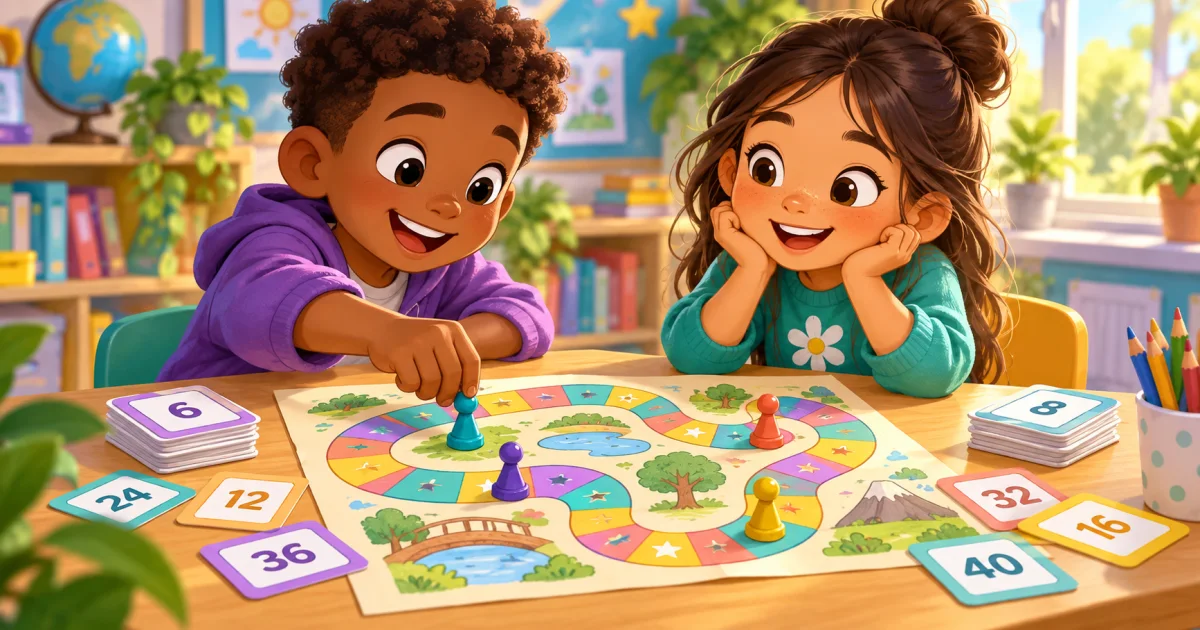
The simplest and most versatile format involves path-style boards where players race from start to finish. Players roll two dice and multiply the numbers. A correct answer lets them move forward by the higher of the two dice; a wrong answer means they stay put. The first player reaching the finish space wins.
Basic setup: Create winding paths with numbered spaces from start to finish. Paths might include 30-50 spaces for games lasting 15-20 minutes. Include occasional special squares offering bonuses (move ahead 5 spaces) or challenges (move back 3 spaces) adding excitement and strategy.
Mathematical variation: Rather than rolling dice then multiplying, spaces themselves display multiplication problems. Players landing on spaces must solve shown problems correctly to remain there, moving back spaces if answering incorrectly. This variation ensures every move involves explicit fact practice.
Strategic elements: Include fork paths where players choose routes. Shorter paths contain harder multiplication facts while longer routes show easier problems. This risk-reward decision-making adds strategic thinking beyond simple fact recall.
Snakes and Ladders Multiplication Adaptation
Adapt the classic snakes and ladders format by adding multiplication problems. Players roll one die and move as usual. Landing on a ladder bottom lets a player climb only after correctly solving the multiplication problem written there, while landing on a snake head still sends them down.
Educational enhancement: Write the facts a child is currently learning, such as the 7 or 8 table, on the ladder squares, so the biggest rewards go to the facts that need the most practice.
Customization tips: Create multiple board versions with different ladder and snake positions preventing memorization of specific patterns. Laminate boards for reusability, using dry-erase markers for changing which multiplication facts appear in different play sessions.
Treasure Hunt and Adventure Games
Themed boards where players collect treasures, rescue characters, or complete quests create narrative engagement alongside mathematical practice. The story elements give meaning to gameplay beyond simply finishing first, particularly appealing to students who respond well to imaginative contexts.
Sample structure: Players move around a board collecting four treasures (or rescuing four characters). Each treasure location shows a times table (treasure one requires solving five problems from the 3 table, treasure two from the 7 table, etc.). First player collecting all treasures wins.
Problem presentation: Use small cards placed on treasure spots rather than permanent board printing. This flexibility allows adjusting difficulty by changing which multiplication facts appear without reprinting entire boards. Teachers can target currently studied tables without creating new complete game boards.
Cooperative variation: Players work together racing against a timer to collect all treasures before time expires. This team structure eliminates competition between students while maintaining the time pressure motivating focused effort.
Strategic Grid Games
Create boards divided into grids where strategic positioning matters. Players might claim spaces by solving multiplication problems, attempting to create rows, columns, or patterns earning points. This format adds tactical decision-making to fact practice.
Three-in-a-row multiplication: Like tic-tac-toe but on larger grids, players take turns solving multiplication problems correctly to claim spaces. The player creating three (or four, or five) adjacent claimed spaces in a row wins. Problems vary by space, with strategically important positions showing harder facts.
Area control game: Players earn points for claiming adjacent space groups forming large connected regions. Solving harder multiplication facts might allow claiming two spaces instead of one, creating interesting tactical choices about whether attempting difficult problems provides sufficient strategic advantage to justify risk.
Monopoly-Style Property Games
Adapt familiar property acquisition gameplay to multiplication practice. Spaces around boards represent different times tables. Landing on spaces requires correctly solving facts from that table, allowing "purchasing" that property. Players collecting complete table "sets" earn bonus points or special abilities.
Mathematical integration: Rather than using money, players use points earned through solving multiplication problems. Harder facts earn more points while easier facts earn fewer. This creates economic reasoning about which properties (tables) to pursue based on point efficiency.
Streamlined versions: Full Monopoly-style games can last hours. Create simplified versions with abbreviated boards and faster gameplay maintaining key mechanics while fitting reasonable practice periods. Ten-minute versions work excellently for transitions while thirty-minute versions suit dedicated game time.
Making Effective Board Games
Design Principles for Educational Value
Ensure every turn involves meaningful multiplication practice. Avoid designs where players simply roll and move without mathematical thinking. The game should require calculation or recall on most if not every turn, maximizing practice density within limited playing time.
Balance luck and skill appropriately. Pure luck games where dice rolls determine everything regardless of mathematical ability disengage strong students while pure skill games where best mathematicians always win discourage struggling learners. Blend both elements allowing diverse students to experience success through good fortune occasionally while skill influences outcomes substantially.
Include self-checking mechanisms when possible. Incorporate answer keys on separate sheets or use formats where incorrect answers naturally disadvantage players (moving backwards, losing turns). This reduces teacher or parent monitoring requirements allowing more independent play.
Create visual appeal attracting student interest. While educational content matters most, attractive graphics increase initial engagement and make games feel valuable rather than hastily prepared afterthoughts. Color coding, thematic illustrations, and clean layouts communicate quality and importance.
Materials and Construction
Print boards on card stock or heavy paper preventing wear during repeated use. Standard copy paper proves too flimsy for games involving dice rolling and piece movement. Card stock's durability justifies the modest additional expense through extended usability.
Laminate boards for maximum longevity. Laminated game boards withstand years of classroom use with dozens or hundreds of students. The plastic coating allows wiping clean and prevents the wear, tears, and spills inevitably occurring during elementary student use.
Assemble complete game kits including boards, rules, and all necessary components. Store everything in labeled envelopes or small boxes kept at accessible locations. Complete ready-to-play kits maximize actual playing time by eliminating setup delays hunting for dice, spinners, or rules.
Create multiple copies for simultaneous small group play. Classrooms benefit from four to six identical game copies allowing entire classes to play at rotation centers. Families with multiple children might keep copies at different locations preventing the frustration of finding games in use when practice time arrives.
Customization for Specific Learning Needs
Design difficulty variants using identical base boards. Print multiple game board copies, writing different multiplication facts on special spaces across versions. Struggling students receive boards showing primarily 2-5 table facts while advanced students' boards feature 6-12 table problems. This differentiation occurs subtly without obvious ability grouping.
Include optional extensions adding complexity. Basic rules might require simple fact solving while advanced rules add time limits, bonus calculations, or multi-step problems. Players can add extensions gradually as skills improve without needing entirely new games.
Create fill-in-blank templates where teachers or parents write current focus facts. Rather than pre-printed permanent problems, templates leave spaces for adding today's practice targets. This flexibility allows single games serving varied purposes across time as student needs evolve.
Classroom Implementation Strategies
Math Center Rotations
Include board games at independent practice centers alongside other activities. While teachers conduct small group instruction, pairs or small groups play games building fact fluency. The self-directed nature of board games makes them excellent for independent work once students learn procedures.
Establish clear center expectations and procedures. Create laminated instruction cards showing setup, play, and cleanup procedures with photographs or illustrations. Clear procedures minimize disruptions from procedural questions, maximizing actual practice time.
Rotate games periodically maintaining novelty. Monday's center might feature race games, Wednesday's treasure hunts, and Friday's strategic grid games. The variety prevents boredom while systematically addressing the same mathematical content through different engaging formats.
Monitor student engagement through observation. Note which games maintain focus versus causing off-task behavior. Replace ineffective games with better alternatives rather than persisting with activities students clearly dislike or misuse.
Whole-Class Tournament Days
Designate special days for multiplication board game tournaments. Multiple pairs or small groups play simultaneously across the classroom with winners of individual games advancing through tournament brackets. These events create excitement while providing substantial concentrated practice.
Mix homogeneous and heterogeneous pairing throughout tournaments. Early rounds might pair similar-ability students ensuring competitive matches where anyone could win. Later rounds could pair mixed abilities allowing peer teaching while keeping stronger students challenged.
Award multiple recognition categories beyond pure victory. "Best Sportsmanship," "Most Improved Player," "Hardest Fact Mastered" and similar awards allow diverse students feeling successful regardless of mathematical ability. This inclusive approach maintains positive attitudes across ability ranges.
Home-School Connection Activities
Send games home for family practice sessions. Include simple parent guides explaining educational goals and suggesting discussion questions deepening learning. These take-home games provide engaging homework alternatives to worksheet packets while fostering family interaction around mathematics.
Create "Game of the Week" rotations where different families borrow classroom games. This system ensures all students access quality materials regardless of home resources while preventing boredom from playing identical games repeatedly without introducing unsustainable expense of providing games for every family.
Encourage families creating their own simple games. Provide blank templates and design guides supporting families inventing personalized games incorporating inside jokes, family member names, or specific interest themes. This creativity increases engagement while teaching that mathematics can be personally relevant.
Extending Learning Beyond Gameplay
Strategic Thinking Discussions
After gameplay, facilitate brief discussions about strategies players used. Questions like "which route did you choose and why?" or "how did you decide which treasure to pursue first?" promote metacognitive awareness about mathematical decision-making.
These conversations reveal student thinking patterns informing future instruction. Teachers discover whether students recognize easier versus harder facts, understand risk-reward tradeoffs, or use probabilistic reasoning about dice outcomes. These insights guide teaching beyond what surface gameplay observes.
Student strategy sharing creates peer learning opportunities. When one player explains their thinking, others gain alternative approaches potentially more effective than their current methods. This collaborative knowledge construction benefits all participants beyond individual discovery.
Analyzing Game Mathematics
Examine probability and expected values underlying dice-based games. Older elementary students can calculate which dice combinations occur most frequently or which strategy paths offer best expected advancement. These investigations connect multiplication practice to broader mathematical thinking.
Graph game outcomes tracking which spaces players land on most frequently or comparing game duration across multiple sessions. The data collection and analysis extends mathematical practice beyond multiplication into statistics and graphing domains.
Modify game rules based on observed gameplay creating more balanced or educationally effective experiences. This game design thinking develops students as mathematical designers rather than merely consumers, dramatically deepening engagement and understanding.
Related: multiplication dice games
Related: multiplication war card game
Related: multiplication memory game
Frequently Asked Questions
Optimal games last 10-20 minutes allowing completion within single practice sessions while maintaining focus without fatigue. Games running longer risk losing student attention while very short games may not provide sufficient practice. Design games with 30-40 spaces or 10-15 problem-solving requirements producing appropriate durations.
Yes, through cooperative variants where players work together against game systems rather than competing against each other. Team challenges, time-based goals, or point targets replacing direct competition maintain engagement for non-competitive students. Offer both competitive and cooperative options accommodating diverse preferences.
Honest genuine competition generally serves children better than artificial wins they often recognize as insincere. However, carefully choose games where luck provides children legitimate winning chances. The goal is fair competition where outcomes reflect combined luck and skill rather than predetermined adult victories or losses.
Quality and variety matter more than quantity. Three to five well-designed games covering different formats and difficulty levels serve most needs effectively. Excessive game collections create overwhelming choice and organization challenges without proportional educational benefit. Invest in durable high-quality games rather than numerous mediocre options.
Both formats offer unique benefits. Board games provide hands-on play, social interaction and screen-free convenience, while digital games such as our times tables speed test offer instant feedback and self-paced practice. Using both keeps practice varied.
Summary
Homemade multiplication board games combine familiar traditional gameplay with focused times table practice creating engaging learning experiences. Essential formats include race-to-finish paths, snakes and ladders adaptations, treasure hunt adventures, strategic grid games, and property acquisition variants. Each format offers unique engagement elements while maintaining rigorous multiplication practice.
Making effective games requires ensuring meaningful mathematical engagement every turn, balancing luck and skill, including self-checking mechanisms, and designing visually appealing materials. Proper construction using card stock, lamination, and complete game kits maximizes durability and usability. Customization through difficulty variants, optional extensions, and fill-in templates accommodates diverse learning needs within single game frameworks.
Teachers implement board games through math center rotations, whole-class tournaments, and home-school connection activities. Extending learning beyond gameplay through strategic thinking discussions, game mathematics analysis, and rules modification develops deeper mathematical thinking. When thoughtfully designed and strategically implemented, multiplication board games provide valuable practice building fluency while maintaining positive attitudes toward mathematics essential for long-term academic success.