Multiplication Memory Game: How to Make and Play It
How to make and play the multiplication memory game: card sets by level, rules, easier and harder variations, and classroom and family ideas.
Print, check and practice
Start with a worksheet and its answer key, or follow the five-day pack. Both are free and available in Letter and A4.
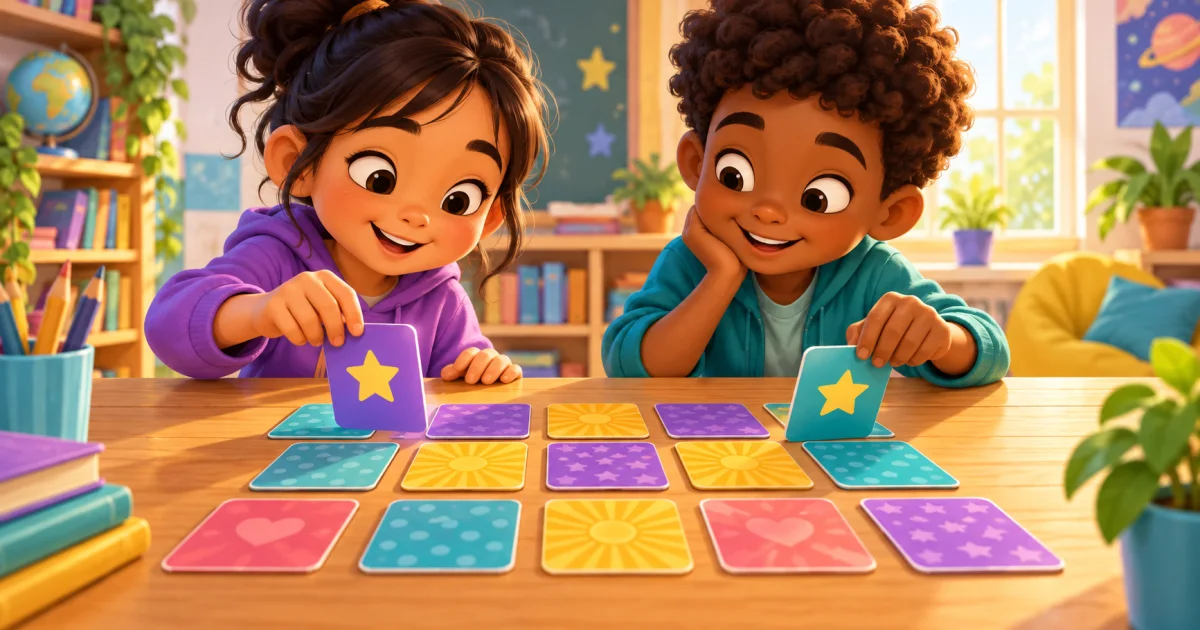
The multiplication memory game transforms the classic concentration card game into powerful times tables practice that exercises working memory alongside mathematical recall. By matching multiplication problems to their products, students practice facts again and again while also exercising their memory and attention. All you need is a set of homemade cards and a flat surface, so it works in classrooms, at homeschool tables and on family game nights.
What You'll Learn
- How to play multiplication memory with complete rules
- How to make card sets for different skill levels
- Variations adapting the game for diverse learners
- The cognitive benefits beyond multiplication practice
- Classroom and home implementation strategies
How Multiplication Memory Works
Game Setup
Create matching card pairs with multiplication problems on some cards and corresponding products on others. For example, one card shows "6 × 7" while its match displays "42." A complete set for the 1-12 times tables would have 144 pairs, so smaller sets focusing on specific tables work much better, especially at first. When two problems share a product (like 6 × 8 and 4 × 12), agree that either "48" card counts as a match.
Shuffle all cards thoroughly and lay them face-down in a grid pattern on a flat surface. Neat rows and columns help players systematically scan for cards during play, though precise arrangement is not required. The face-down orientation creates the memory challenge central to the game.
Two to four players work best, though solo play provides valid practice. More than four players causes excessive waiting between turns that diminishes engagement. For large groups, create multiple simultaneous games with smaller player groups at separate stations.
Basic Play
The first player flips any two cards face-up so all players can see. If the cards match (a problem and its correct product), the player keeps the pair and takes another turn. If cards do not match, the player flips them back face-down in their original positions and the next player takes a turn.
Play continues clockwise with players trying to remember card locations revealed during previous turns. The player collecting the most pairs when all cards have been claimed wins. This simple scoring system creates clear outcomes without requiring complex calculation.
The memory challenge intensifies as more cards reveal then flip back down. Players must track multiple problem-product pairs across numerous grid locations, exercising working memory capacity alongside multiplication recall.
Strategic Elements
While luck influences early turns when few cards have been revealed, strategy increasingly matters as play progresses. Attentive players remember card locations revealed during others' turns, gaining advantages over inattentive opponents.
Some players use spatial memory strategies, mentally noting "the card showing 48 is near the top left corner." Others use mathematical patterns, recognizing "that's a 6-table product" to connect visually similar problems. These varied approaches demonstrate different cognitive strengths.
The dual-task demand of remembering locations while calculating products creates productive cognitive challenge. Students must hold in mind both "where is 42" and "what is 6 × 7" simultaneously, building mental management skills valuable across academic domains.
Creating Custom Memory Card Sets
Determining Appropriate Set Size
Full 144-pair sets covering all the 1-12 times tables prove overwhelming for beginners and create hour-long games exhausting attention spans. Start with smaller focused sets building systematically toward comprehensive practice.
Beginner sets (20-30 pairs): Include only 2, 5, and 10 tables creating manageable challenges while focusing on easiest facts. Games with 20 pairs typically last 10-15 minutes, perfect for maintaining engagement without fatigue.
Intermediate sets (40-60 pairs): Add 3, 4, 6, and 9 tables for students solid with basics ready for expanded practice. These moderate-length games provide substantial review without overwhelming memory capacity.
Advanced sets (80-100+ pairs): Include most of the 1-12 tables for students with strong working memory and extensive fact knowledge. Reserve full sets for older students or those specifically training memory skills alongside multiplication.
Adjust set size based on observation. If students locate pairs easily showing boredom, increase cards adding challenge. If struggling to track locations appears stressed rather than engaged, reduce set size temporarily.
Choosing Card Content and Format
Standard memory games use identical images creating visual matching. Educational versions require mathematical matching where visual cards differ but represent equivalent values. This cognitive demand increases difficulty appropriately for learning contexts.
Traditional problem-product pairs: One card shows "7 × 8" while its match displays "56." This format requires students to calculate products then locate corresponding numerals, building the problem-answer connection central to fact memorization.
Double problem format: Both cards show problems creating the same product, like "6 × 8" matching "8 × 6." This variation emphasizes the commutative property and develops flexible thinking about factor relationships.
Word problem matches: One card presents a brief multiplication story problem while its pair shows the numerical product. This format builds word problem comprehension alongside fact practice, valuable for students struggling to recognize multiplicative situations.
Visual representation pairs: Cards showing arrays or groups of objects match to numerical products. A card depicting six rows of seven dots pairs with "42," connecting concrete quantities to abstract symbols.
Choose formats matching instructional goals and student needs. Traditional problem-product pairs work well for fact memorization while alternative formats develop broader mathematical understanding.
Design and Production Tips
Print cards on sturdy card stock preventing see-through that allows identifying face-down cards. Standard paper proves too thin for memory games requiring repeatedly flipping cards. Alternatively, print on regular paper and glue to recycled greeting cards or cardboard.
Use clear large fonts ensuring easy reading from typical playing distance. Font sizes below 18 points prove difficult for many elementary students to read quickly, slowing gameplay and causing frustration unrelated to mathematical content.
Include small visual cues helping students verify matches. Subtle color-coding where all 7-table problems share border colors aids self-checking while maintaining the memory challenge. However, avoid making visual cues so obvious they eliminate mathematical thinking.
Laminate finished cards for durability. Memory games involve extensive handling and repeated use quickly damages unprotected paper. Lamination represents upfront investment but creates resources lasting years with multiple students.
Store cards in labeled containers noting the times tables included. Clear organization enables quickly selecting appropriate sets for current learning goals without sorting through mixed collections.
Game Variations for Different Learning Needs
Simplified Versions for Beginners
Reduce memory demand temporarily while students learn game mechanics and build confidence. Face-up practice where all cards remain visible eliminates memory challenge, focusing purely on mathematical matching. This scaffolding works well for initial introduction.
Allow chart references during play. Students uncertain about products can check multiplication charts before committing to matches. The goal at this level is learning facts, not testing current knowledge. Chart use provides just-in-time learning exactly when students need specific facts.
Extend time for calculation before revealing second card. Rather than immediate flipping, allow students to mentally solve problems and think carefully before attempting matches. This self-paced play reduces pressure while maintaining game structure and motivation.
Use smaller grids with wider spacing between cards. Dense grids prove visually overwhelming for some students, particularly those with visual processing or attention challenges. Generous spacing and limited cards create clearer less distracting playing fields.
Advanced Challenges
Add a third matching card creating trios instead of pairs. Sets might include "6 × 8," "48," and a word problem yielding 48. Players must collect all three cards to score, substantially increasing difficulty and memory demand.
Introduce a timer requiring players to make matches within specified periods. This speed element rewards quick calculation and recall, building fluency beyond accuracy. However, reserve timed versions for confident students as pressure triggers anxiety in vulnerable learners.
Create wild cards allowing players to claim any problem-product pair when drawing wild cards. These chance elements add unpredictability maintaining engagement through surprising reversals where trailing players suddenly catch leaders.
Implement penalty cards causing players to return pairs when revealed. The risk-reward dynamic adds strategic thinking about which cards to flip, transforming simple memory into calculation of probabilities and expected values.
Team Cooperative Play
Partner students in pairs sharing turns. Partners discuss which cards to flip, collaborating on calculations and location recall. The cooperation reduces individual pressure while creating peer teaching opportunities as stronger students support struggling partners.
Create whole-class team challenges where groups collectively try to complete game in minimum turns or time. This cooperative structure eliminates competition between students, focusing instead on collective problem-solving and shared goal achievement.
Implement relay formats where team members take sequential turns, earning points for their groups. Teams cheer for teammates and strategize collectively about which locations to attempt, building classroom community through mathematical activity.
Cognitive Benefits Beyond Multiplication
Working Memory Development
Memory games exercise working memory, the ability to hold and use information for a short time. Working memory matters for learning in every subject.
The dual demand of remembering locations while calculating products creates particularly powerful working memory training. Students cannot succeed through rote location memory alone because they must also perform mathematical operations, forcing simultaneous cognitive processing.
Keep expectations realistic, though. Research on memory training suggests that practice mostly improves the trained task itself and does not reliably boost memory in general. The main value of the game is that it gets children recalling facts again and again while they enjoy themselves.
However, excessive cognitive load proves counterproductive. If games become so difficult students feel overwhelmed, reduce cards or simplify calculations ensuring productive struggle rather than frustrated defeat. Challenge should stretch but not break developing capacities.
Visual-Spatial Memory Training
Tracking card locations across grid spaces develops visual-spatial memory, the ability to recall positions and arrangements in space. This skill supports geometry learning, map reading, and various real-world navigation challenges.
Students use different spatial strategies. Some create mental photographs of grid layouts while others encode relative positions using landmarks. Observing which strategies students spontaneously employ provides insights into cognitive strengths informing instructional approaches.
Spatial reasoning is linked to success in mathematics, so games that make children think about positions and arrangements are a welcome extra, even if the game itself is not a substitute for teaching geometry.
Attention and Concentration
Success requires sustained attention across entire games lasting 15 to 30 minutes. Students must focus continuously, watching other players' turns rather than mentally checking out between their own actions. This extended concentration builds capacities valuable across all learning contexts.
The game structure naturally rewards attention. Students who watch carefully gain competitive advantages through knowledge of card locations revealed during others' turns. This intrinsic motivation develops attention more effectively than external demands to "pay attention."
Games also give children a positive experience of concentrating for a sustained stretch, something teachers can refer back to during less exciting tasks.
Classroom Implementation Strategies
Math Center Rotations
Multiplication memory works excellently at independent centers because students play without requiring teacher supervision once rules are learned. While teachers work with small groups or individual students, pairs at centers practice facts through self-directed gameplay.
Provide laminated instruction cards at centers summarizing rules and resolving common questions. Visual step-by-step guides with photographs or illustrations minimize interruptions from students asking procedural questions, maximizing actual playing time.
Store complete game sets in labeled containers at permanent center locations. Clear organization eliminates setup time and confusion about which materials belong to which games. Consider assigning student helpers responsible for checking set completeness and organization.
Rotate card sets periodically preventing boredom from repetitive exposure. Monday's center might feature 2-5 tables, Wednesday's 6-9 tables, and Friday's mixed tables. This variety maintains novelty while systematically reviewing different content.
Whole-Class Tournament
Organize class tournaments with bracket structures similar to sports championships. Students play multiple opponents across several sessions with winners advancing through rounds. This extended format provides substantial practice while the competitive narrative maintains interest.
Award various recognition categories beyond simple victory. "Most Improved Player," "Best Sportsmanship," and "Most Difficult Fact Mastered" allow multiple students to feel successful regardless of game outcomes. Diverse recognition prevents strongest math students dominating all appreciation.
Use tournament results diagnostically. Note which facts cause difficulty across multiple students suggesting instructional gaps requiring re-teaching. Individual struggles patterns inform intervention grouping and targeted practice assignments.
Cooperative Class Challenge
Set class goals like "complete 100 total games this month" or "collect 500 pairs collectively." Track progress on bulletin board displays showing advancement toward goals. This cooperative structure builds community while providing motivation for consistent practice.
Celebrate collective achievement with class-wide rewards. Perhaps reaching goals earns extra recess, special privileges, or certificates of accomplishment. Shared rewards emphasize that everyone's practice contributes to communal success.
Include struggling students meaningfully in collective challenges. Every game played counts regardless of individual success rates. This inclusion prevents exclusion feelings some students experience in purely competitive structures where they never win.
Home and Family Use
Making Memory Games Family Time
Play multiplication memory during family game nights alongside traditional recreational games. The inclusive format accommodates mixed-age groups where younger siblings can compete successfully against older students when card content matches their level.
Parents without strong multiplication recall benefit from playing alongside children. The activity levels the mathematical playing field since memory capacity matters as much as fact knowledge. Children often enjoy opportunities to win against parents through superior memory.
Create friendly intergenerational competition. Grandparents visiting might play multiplication memory with grandchildren, providing quality interaction around educational content. The low-barrier activity requires no special knowledge or preparation beyond printed cards.
Supporting Struggling Learners
Use memory games as opportunities for calm one-on-one practice. The game format makes repetitive fact practice feel less tedious than flashcard drills while providing natural conversation openings for discussing strategies and celebrating small successes.
Allow struggling children to use multiplication charts during home play without judgment. The goal is building comfort and gradual knowledge, not testing under pressure. Chart references during game play create learning opportunities as students repeatedly look up the same struggling facts.
Focus feedback on effort and strategy rather than final scores. Notice when children remember card locations or calculate efficiently, praising specific observable behaviors. This feedback builds confidence and indicates exactly which actions to repeat.
Maintain patient encouraging attitudes even when progress feels slow. Every successful match represents learning, and every game played provides valuable practice regardless of outcome. Parental stress about performance transfers to children, increasing anxiety that ironically impairs the performance parents want to improve.
Related: multiplication board games
Related: multiplication war card game
Related: multiplication dice games
Frequently Asked Questions
Begin with 20 to 30 pairs focusing on easiest facts (2, 5, 10 tables). This manageable set builds confidence while teaching game mechanics. Expand to 40-60 pairs as comfort and skills increase, eventually reaching comprehensive sets for advanced players.
Yes, solo play provides valid practice. Students flip pairs trying to clear the board in minimum turns or fastest time, competing against personal records. While social play offers additional benefits, independent practice still exercises memory and multiplication simultaneously.
Large sets may overwhelm current working memory capacity. Reduce card quantities creating more manageable challenges. Some students benefit from explicitly taught memory strategies like creating mental photographs of grid layouts or grouping cards by proximity.
Allow genuine competition where outcomes reflect actual performance. Children sense artificial wins, potentially losing respect for activities they dominate too easily. However, parents might choose card sets allowing children to demonstrate strengths rather than playing at levels guaranteeing parental victory.
Both methods work effectively for different purposes. Memory games provide extended engaging practice with built-in working memory training but slower fact exposure rates. Flashcards offer focused rapid-fire drilling efficiently building automaticity. Balanced approaches using both methods benefit most students.
Summary
Multiplication memory transforms the classic concentration game into educational practice exercising working memory alongside mathematical recall. Players match multiplication problems to products, requiring calculation skills and location memory simultaneously. Custom card sets accommodate skill levels from beginners practicing the 2 to 5 tables to advanced students tackling most of the 1-12 tables.
Game variations including simplified beginner versions, advanced challenges, and team cooperative formats address diverse learning needs and preferences. Beyond multiplication practice, memory games exercise attention and spatial memory in an enjoyable way.
Teachers effectively implement multiplication memory through independent center rotations, whole-class tournaments, and cooperative class challenges. Families use games during dedicated practice times or integrated into recreational family game nights. When implemented thoughtfully with appropriate difficulty levels and supportive attitudes, multiplication memory provides engaging practice that builds mathematical fluency.