3rd Grade Multiplication: Standards, Plan and Resources
What third graders need to learn about multiplication, a year-long teaching sequence from concepts to fluency, resources, differentiation and home support.
Print, check and practice
Start with a worksheet and its answer key, or follow the five-day pack. Both are free and available in Letter and A4.
Third grade represents the critical year when most students transition from conceptual multiplication understanding to automatic fact fluency. How this year goes shapes how confident many children feel about mathematics afterwards. This guide covers the standards, a year-long teaching sequence, resources, differentiation and home support.
What You'll Learn
- Complete third grade multiplication curriculum standards and expectations
- Effective instructional sequences building from concepts to fluency
- Essential resources including worksheets, games, and assessment tools
- Differentiation strategies supporting varied student needs
- Parent communication and home support recommendations
Third Grade Multiplication Standards
Common Core State Standards
CCSS.MATH.CONTENT.3.OA.A.1 requires students interpreting products of whole numbers as total numbers of objects in specified groups. For example, understanding 5 × 7 as the total number of objects in 5 groups of 7 objects each demonstrates this interpretive competence beyond mere calculation ability.
CCSS.MATH.CONTENT.3.OA.A.3 expects students using multiplication and division within 100 to solve word problems involving equal groups, arrays, and measurement quantities. This application standard ensures students recognize when multiplication applies in varied contexts, not just during designated "multiplication time" in mathematics class.
CCSS.MATH.CONTENT.3.OA.A.4 asks students to determine the unknown whole number in a multiplication or division equation relating three whole numbers, such as 8 × ? = 48 or 56 ÷ 7 = ?. Solving for unknowns in any position builds early algebraic thinking.
Most significantly, CCSS.MATH.CONTENT.3.OA.C.7 demands fluently multiplying and dividing within 100, using strategies such as the relationship between multiplication and division or properties of operations. The standard adds that by the end of Grade 3, students know from memory all products of two one-digit numbers, a substantial expectation.
State and District Variations
While Common Core provides widespread baseline expectations, some states and districts maintain unique standards or pacing. Texas TEKS, for instance, expects third graders representing and solving multiplication problems using arrays, area models, and equal groups while recalling facts through 10 × 10 with automaticity by year end.
Some international curricula introduce multiplication earlier or later than American third grade. UK National Curriculum introduces times tables in Year 2 (equivalent to first grade in the US) with mastery expectations extending through Year 4 (third grade). Understanding your specific context's expectations proves essential for appropriate instruction.
Regardless of specific standards language, most third grade programs share common goals: understanding multiplication meaning, learning computational strategies, memorizing basic facts, and applying multiplication to solve problems. The timing, emphasis, and assessment methods vary but core content remains consistent.
Realistic Achievement Expectations
While standards specify "fluency by year end," actual student achievement varies substantially, and many classes end the year with a group of students who are still building speed on the harder facts.
This doesn't represent instructional failure but reflects normal developmental variation. Some students achieve fluency by mid-year while others require extended practice into fourth grade and beyond. The goal remains appropriate: all students should achieve fluency eventually through continued support.
More realistic expectations acknowledge this variation. By year end, most students should demonstrate solid conceptual understanding, computational strategy competence, automaticity on easier facts (0, 1, 2, 5, 10 tables), and emerging automaticity on harder facts (3, 4, 6, 7, 8, 9 tables). Those not yet automatic should show clear progress trajectories suggesting eventual mastery with continued practice.
Effective Instructional Sequence
Foundation Phase: Conceptual Understanding (Weeks 1-4)
Begin third grade multiplication with substantial conceptual development even though many students encountered multiplication in second grade. Never assume all students enter with solid foundations. Comprehensive concept review benefits struggling students while enriching stronger students' understanding.
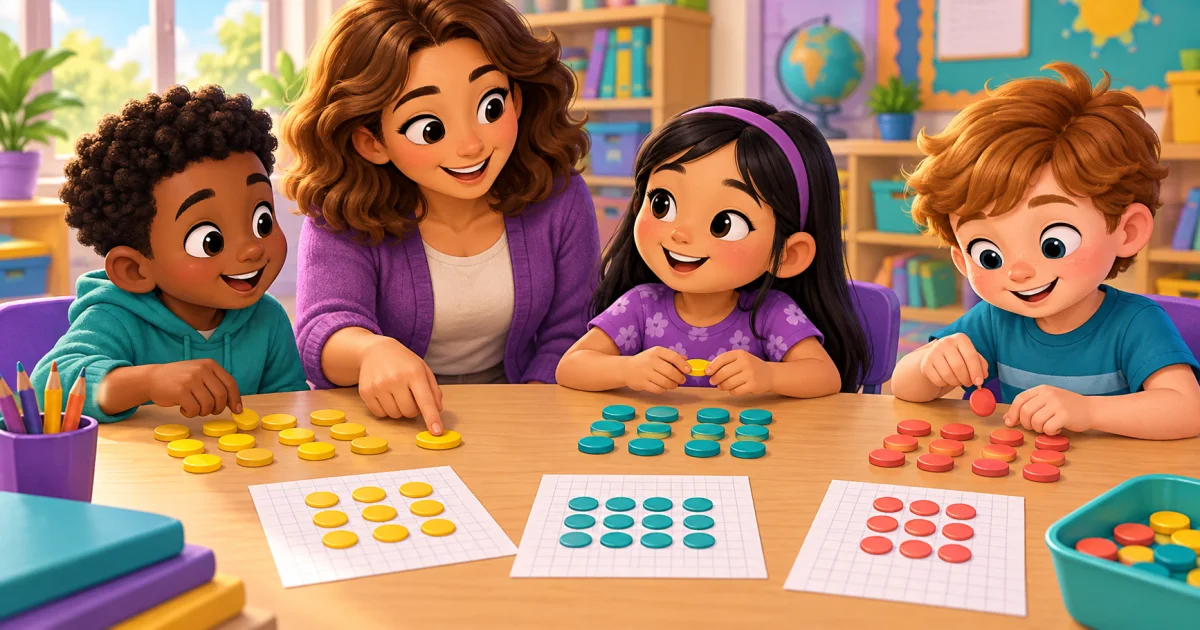
Equal Groups Model: Present multiplication as combining equal groups. Extensive work with manipulatives creating and counting groups builds tangible understanding. Three groups of four objects always totals twelve objects regardless of what objects are used or how they're arranged.
Array Model: Systematic rectangular arrangements reveal multiplication structure clearly. Arrays make commutative property obvious (3 × 4 array rotated becomes 4 × 3) while connecting multiplication to area concepts introduced later in the year.
Repeated Addition: Connect multiplication to known addition facts. While not the end goal, repeated addition provides access using existing knowledge. Students comfortable with addition can solve multiplication problems while gradually recognizing more efficient multiplicative thinking.
Spend extensive time with varied real-world contexts ensuring students recognize multiplication situations across diverse scenarios. Shopping situations, classroom organization problems, cooking measurement, and sports statistics all present natural multiplication contexts making mathematics meaningful beyond classroom walls.
Strategy Development Phase (Weeks 5-12)
After solid conceptual foundations, teach computational strategies producing accurate efficient problem-solving without requiring pure memorization. These strategies provide scaffolding supporting students during the lengthy memorization process while building number sense.
Skip Counting: Fluent skip counting by 2s, 3s, 4s, 5s, and 10s enables solving multiplication problems through counting sequences. While not automatic recall, skip counting produces correct answers efficiently enough to function during early learning. Extensive skip counting practice pays ongoing dividends.
Doubling and Halving: Use known facts to derive unknown ones. If students know 4 × 6 = 24, they can determine 8 × 6 by doubling the product (48). If they know 8 × 7 = 56, they can find 4 × 7 by halving (28). These relationships build flexible strategic thinking.
Decomposing Factors: Break harder problems into easier components. Calculate 7 × 6 as (5 × 6) + (2 × 6) = 30 + 12 = 42. While multi-step, this strategy ensures success when automatic recall fails while developing algebraic thinking about the distributive property.
Using Properties: Explicitly teach commutative, associative, and distributive properties as problem-solving tools. Understanding that 7 × 8 equals 8 × 7 instantly doubles the number of known facts. The identity property (any number times 1 equals itself) and zero property (any number times 0 equals 0) handle entire fact families easily.
Fact Fluency Development (Weeks 13-30)
Fluency development occurs gradually over many months through distributed practice combining varied activities. No single approach produces fluency for all students; comprehensive programs include multiple methods addressing diverse learning preferences.
Systematic Table Sequence: Teach tables in logical progression from easiest to hardest. Typical sequence: 0 and 1 (properties), 2 (doubling), 5 (skip counting), 10 (place value), 3, 4, 6, 9, 7, 8 (increasingly difficult). Mastery-based progression ensures solid foundations before adding complexity.
Daily Practice Routines: Brief frequent practice outperforms long infrequent sessions for building automaticity. Five to ten minutes daily of varied engaging practice produces better results than hour-long weekend study marathons. Consistency matters more than individual session length.
Varied Practice: Combine written worksheets, oral recitation, digital games, hands-on activities, songs, and movement-based practice. Variety maintains engagement and gives students more than one route to each fact, and different students respond to different activities.
Progress Monitoring: Regular brief assessments document improving fluency over time. Track both speed and accuracy showing students tangible evidence that practice produces results. Visible progress motivates continued effort even when complete mastery remains distant.
Essential Curriculum Resources
Core Instructional Materials
Comprehensive Textbook Programs: Established curricula like Envision Math, Go Math, or Eureka Math provide complete scope and sequence including lesson plans, student materials, and assessments. While requiring purchase, these commercial programs ensure systematic coverage of all required content reducing teacher planning burden.
Teacher-Created Resources: Many excellent multiplication units exist as free downloads from educational websites or teacher marketplaces. While requiring more assembly into coherent sequences, free resources allow budget-conscious customization matching specific student needs.
Manipulative Sets: Essential concrete materials include two-color counters, linking cubes, base-ten blocks, and square tiles. These physical objects make abstract multiplication concepts tangible particularly for students requiring extended concrete experiences. Shared classroom sets serve entire classes across multiple years.
Practice Resources
Printable Worksheets: Free collections are easy to find, including our printable multiplication worksheets with answer keys. Look for varied formats including straight computation, word problems, missing factor equations, and mixed operations preventing mindless repetitive drill. Answer keys enable student self-checking or quick teacher grading.
Flashcards: Simple but effective tools for building automatic recall. Commercial sets, printable flashcards, or student-created cards all work well. Digital flashcard apps provide convenient alternative to physical cards while tracking student performance data.
Multiplication Games: Board games, card games, dice games, and online games transform practice into entertainment. Games provide extensive fact exposure through enjoyable formats students choose voluntarily rather than avoiding. Maintain collections offering variety preventing boredom from excessive repetition.
Multiplication Charts: Visual reference tools such as a printable multiplication chart support struggling students while reinforcing patterns for all learners. Permit chart use during initial practice withdrawing gradually as automaticity develops. Chart familiarity itself builds understanding through repeated reference.
Digital Resources and Technology
Adaptive Practice Platforms: Programs like Khan Academy, IXL, or Prodigy adjust difficulty matching individual student performance providing appropriately challenging practice for diverse learners simultaneously. While requiring internet access, these platforms offer features impossible in paper materials.
Educational Game Sites: Free websites like Math Playground, Multiplication.com, or Cool Math Games provide engaging practice through entertaining formats. Quality varies requiring teacher preview, but many excellent options exist requiring no cost or registration.
Interactive Whiteboard Activities: For classrooms with interactive displays, Smart Board or Promethean files provide collaborative whole-class activities. Students manipulate virtual objects, solve problems collaboratively, and engage with content in ways transcending paper worksheets.
Assessment Tools
Diagnostic Assessments: Pre-unit tests reveal baseline knowledge informing instructional starting points. Knowing which students master which facts allows differentiated instruction targeting specific needs rather than treating all students identically.
Formative Assessments: Regular brief checks monitor ongoing progress. Weekly mini-quizzes, exit tickets, or informal observations provide data guiding instructional adjustments. Formative data informs teaching rather than grading students.
Summative Assessments: End-of-unit tests measure overall achievement against standards. These higher-stakes assessments determine whether students mastered objectives sufficiently to progress. Results influence report card grades and placement decisions.
Fluency Screeners: Timed tests measuring how many facts students solve correctly in one to three minutes assess automaticity specifically. While controversial given potential anxiety production, fluency screening provides valuable data about whether students achieved true automaticity versus slower calculation.
Differentiation Strategies
Supporting Struggling Students
Some third graders struggle significantly with multiplication despite good general instruction. They need extra, targeted support so that gaps do not build up and slow down later mathematics.
Small Group Intervention: Pull small groups for additional explicit instruction targeting specific struggling areas. Perhaps 15 to 20 minutes daily of focused teacher-led practice supplements general classroom instruction. This intensified exposure benefits students who need more time achieving mastery.
Concrete Materials Extension: Some students require prolonged concrete manipulation extending beyond typical timelines. Rather than rushing to abstract symbols, allow extended hands-on experiences until conceptual understanding solidifies. Better late abstract understanding than premature confusion.
Reduced Fact Sets: Rather than expecting mastery of all facts simultaneously, focus struggling students on essential subsets. Perhaps prioritize 0, 1, 2, 5, 10 tables deferring harder facts until easier ones achieve automaticity. Incremental progress beats overwhelming paralysis.
Alternative Strategies: Teach multiple approaches allowing students selecting methods matching their thinking. Some students succeed with skip counting while others prefer repeated addition or using known facts to derive unknowns. Strategy flexibility lets each student use the route that makes sense to them.
Assistive Technology: Calculators or multiplication charts provide access to grade-level content while automaticity develops. The accommodation ensures students can participate in problem-solving and applications rather than being excluded from all mathematics until memorization completes.
Challenging Advanced Students
While many third graders struggle, some achieve fluency rapidly requiring enrichment preventing boredom and behavioral problems from unchallenging work.
Extended Fact Ranges: Students mastering facts through 10 × 10 can extend to 11 × 11 or 12 × 12, learning multiplication facts beyond minimum grade-level expectations. This vertical extension provides continued challenge within the same topic.
Multi-Digit Multiplication: Introduce two-digit by one-digit multiplication (like 23 × 4) for students ready for additional complexity. While typically fourth grade content, capable third graders can begin this work as enrichment.
Complex Word Problems: Provide multi-step problems requiring multiplication within longer problem chains or combining multiplication with other operations. "Sarah has 4 boxes with 6 crayons each. She gives 5 crayons to her friend. How many crayons remain?" adds complexity beyond basic multiplication.
Mathematical Investigations: Engage advanced students exploring multiplication patterns, relationships, and properties through open-ended investigations. "What patterns do you notice in the 9 times table?" or "How are multiplication and division related?" develop deep mathematical thinking beyond computation.
Home Support and Parent Communication
Parent Education
Many parents want supporting home learning but feel uncertain about current teaching methods differing from their own school experiences. Proactive parent education prevents well-intentioned but counterproductive home practices.
Back-to-School Information: Provide clear explanation of third grade multiplication expectations, instructional approaches, and practice recommendations during fall orientation or welcome letters. This early communication establishes shared understanding preventing later confusion.
Strategy Sharing: Teach parents the computational strategies students learn in class. When parents understand how schools teach doubling, decomposing, or using properties, they can support rather than confuse children through conflicting methods. Brief parent workshops or video tutorials accomplish this effectively.
Realistic Timeline Communication: Help parents understanding that fluency develops over months, not weeks. Anxiety about "falling behind" drives counterproductive pressure. Reassuring parents that varied timelines are normal reduces home stress supporting better learning.
Home Practice Recommendations
Short Daily Practice: Recommend 10 to 15 minutes daily of varied practice rather than long weekend sessions. Brief consistent engagement produces superior learning while fitting more easily into busy family schedules. Suggest specific activities parents can implement easily.
Game-Based Practice: Provide lists of simple home games requiring minimal materials. Card games using standard decks, dice games, or online games transform practice into family fun rather than academic drudgery. The enjoyment increases voluntary practice time.
Real-World Application: Encourage parents highlighting multiplication in daily life. Setting tables, organizing supplies, calculating sports statistics, or measuring cooking ingredients demonstrate mathematics relevance beyond worksheets. These authentic contexts build positive mathematical attitudes.
Positive Environment: Emphasize maintaining encouraging supportive attitudes avoiding frustration or pressure. Parental anxiety transmits to children undermining learning. When practice sessions become stressful, recommend breaks or switching to different activities. Some practice under positive conditions beats no practice due to battles.
Related: how to memorize multiplication tables
Related: when kids learn times tables
Related: hardest times tables
Frequently Asked Questions
Continue practice into fourth grade and beyond as needed. While standards specify third grade fluency, learning doesn't stop at arbitrary calendar points. Most students achieve automaticity eventually with continued appropriate support. Focus on progress rather than absolute timeline compliance.
Recommendations vary but typically 15 to 30 minutes daily within comprehensive 60 to 90 minute mathematics blocks. Multiplication receives substantial emphasis during third grade while maintaining instruction in place value, fractions, measurement, and geometry. Balance prevents overemphasizing single topics at others' expense.
Typically yes, though increasingly curricula introduce them simultaneously as inverse operations. Understanding multiplication provides foundations for division understanding. However, showing their relationship early prevents treating them as completely separate unrelated operations.
Delay timed fluency tests until most students have learned all facts through less stressful practice methods. Perhaps introduce timed assessment during spring after extensive fall and winter learning. This timing allows students achieving some automaticity before testing rather than being assessed on emerging knowledge.
Technology provides valuable supplemental practice and engagement but shouldn't replace hands-on concrete experiences or human instruction. Perhaps 20 to 30 percent technology-based practice within balanced programs combining manipulatives, paper materials, games, and digital resources. Quality matters more than quantity regarding technology use.
Summary
Third grade multiplication curriculum encompasses conceptual understanding development, computational strategy instruction, fact fluency building, and problem-solving application across the school year. Standards expect students interpreting multiplication meaning, using it to solve problems, and demonstrating automatic fact recall through 10 × 10 by year end, though achievement varies among individuals.
Effective instruction follows systematic progressions from concrete conceptual foundations through strategic problem-solving toward automatic fluency over many months. Essential resources include comprehensive textbooks or teacher-created units, manipulative materials, varied practice tools including worksheets and games, digital platforms, and formative and summative assessments documenting progress.
Differentiation supports both struggling students through interventions and accommodations and advanced students through enrichment and extensions. Parent education and home support recommendations strengthen school learning while maintaining positive mathematical attitudes essential for long-term success. Comprehensive balanced approaches addressing conceptual understanding, strategies, fluency, and application produce optimal outcomes for diverse third grade learners navigating this critical mathematical milestone.