3rd Grade Multiplication Games: 8 Games Matched to the Year
Eight 3rd grade multiplication games matched to what third graders learn: arrays, turnaround facts, word problems and fluency within 100.
Print, check and practice
Start with a worksheet and its answer key, or follow the five-day pack. Both are free and available in Letter and A4.
Third grade is the year multiplication arrives in earnest. Children move from "groups of" to arrays, learn that 3 × 8 and 8 × 3 give the same answer, solve their first multiplication word problems, and by the end of the year are expected to know the products of one-digit numbers from memory. The eight games below are each matched to one of those goals, so you can choose a game for the skill your class is working on.
What You'll Learn
- What third graders learn about multiplication
- Two games for understanding equal groups and arrays
- Two games for turnaround facts and missing numbers
- Two games for word problems
- Two games for fluency with all facts to 10 × 10
What Third Graders Learn About Multiplication
In the United States, the Common Core grade 3 standards ask children to understand multiplication as equal groups and arrays, solve word problems with multiplication and division within 100, find an unknown number in a fact such as 8 × ? = 48, use properties such as the commutative property (3 × 8 = 8 × 3), and, by the end of the year, know from memory all products of two one-digit numbers. Other countries order the work differently; our article on times tables in Year 3 covers the English curriculum. For a full overview of the year, see 3rd grade multiplication.
Eight- and nine-year-olds enjoy rules, teams and a bit of competition, and they can manage simple scorekeeping. They also notice quickly when a game is "babyish", so the games below add choices and strategy rather than only speed.
Games for Equal Groups and Arrays
1. Array Capture
You need: grid paper, two dice, two colored pencils. Players take turns rolling the dice and drawing an array with that many rows and columns anywhere on the grid (a roll of 4 and 3 is a 4 × 3 rectangle), then write the fact inside it. If an array no longer fits, the player misses a turn. When the page is full, each player adds up the squares they colored. Children see that 4 × 3 covers exactly 12 squares, and they start to plan: a big array scores more but is harder to fit.
2. Equal Groups Café
You need: a menu with prices from 2 to 10 and counters or play coins. One child orders several of the same item ("six muffins at 4 coins each"), and the waiter must show the bill as equal groups of counters before writing the fact: 6 × 4 = 24. Swap roles after each order. The café makes the link between a real situation and the fact, which is the heart of word problems later.
Games for Turnaround Facts and Missing Numbers
3. Turnaround Memory
Make memory cards where each pair is a fact and its turnaround: 3 × 8 and 8 × 3, 6 × 7 and 7 × 6. A player who finds a pair must say the product to keep it. Children quickly realize that knowing one fact gives them two, which cuts the number of facts to learn almost in half. For card-making tips, see our multiplication memory game.
4. Missing Factor Bingo
Bingo cards hold the numbers 1 to 10. Instead of calling a fact, call a fact with a gap: "eight times what is forty-eight?". Children cover 6. This practices the unknown-number problems third graders meet and prepares them for division, since 8 × ? = 48 is the same question as 48 ÷ 8. More ideas for bingo cards are in our multiplication bingo guide.
Games for Word Problems
5. Story Dice
Roll two number dice and one picture card (bags, boxes, legs, wheels, weeks). The player tells a short story that uses all three: "There are 5 bags with 4 apples in each bag." The next player must turn it into a question and solve it. Writing problems for each other shows whether children know when multiplication is the right operation. Our article on grade 3 multiplication word problems has examples of each problem type.
6. Treasure Hunt
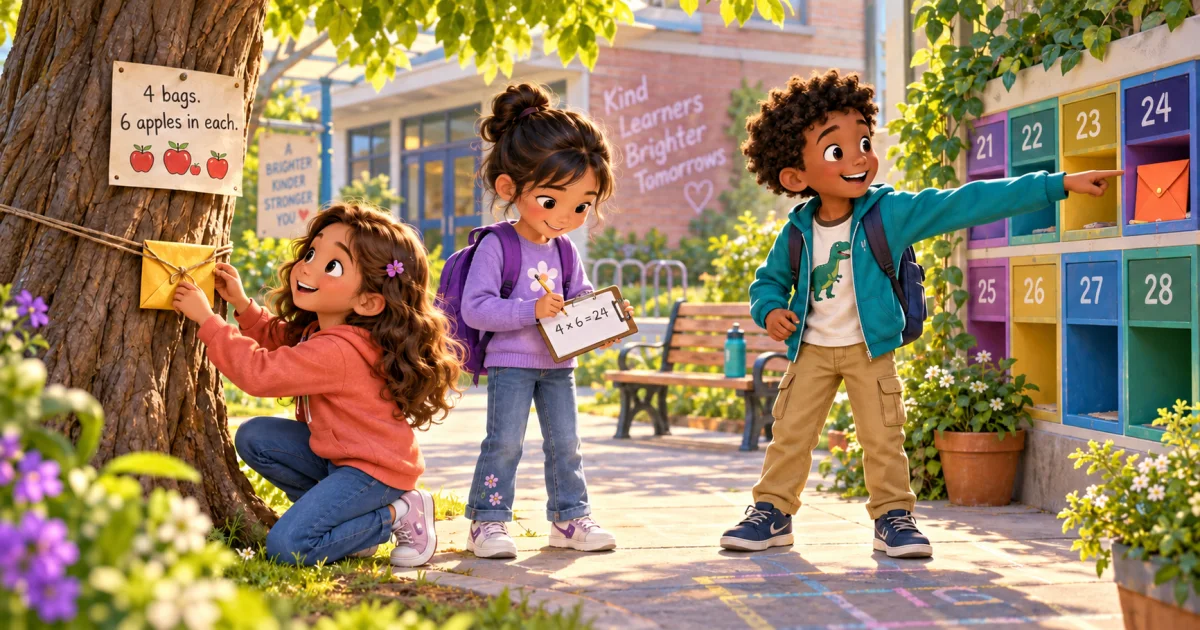
Hide short word problems around the classroom or playground. Each answer is a number that points to the next clue, for example the locker or the page numbered with the answer. Teams carry a clipboard and must write the fact for every problem before they move on. The last clue leads to a small reward or a class privilege.
Games for Fluency
7. Around the World
One child stands behind a seated classmate; call a fact and the faster answer moves on to the next desk. Call only the tables you have taught, mix in easier facts so everyone can win a round, and listen for the facts that cause hesitation. Our classroom multiplication games article has more whole-class games like this one.
8. Beat Your Score
Fluency means answering without counting. A one-minute speed test on a single table gives each child a score, and the game is simply to beat yesterday's score. Because children compete with themselves, slower children enjoy it as much as fast ones. Teachers can copy a ready-to-start link for any table from our page for teachers and post it in Google Classroom or Schoology.
Fitting Games Into the Year
- Autumn: Array Capture and the Equal Groups Café while the class learns what multiplication means, with the 2s, 5s and 10s.
- Winter: Turnaround Memory and Missing Factor Bingo as the 3s, 4s, 6s and 8s arrive, plus Story Dice once a week.
- Spring: Around the World and Beat Your Score for the 7s and 9s and mixed facts, with Treasure Hunt as a review before tests.
Frequently Asked Questions
Under the Common Core, all products of two one-digit numbers (up to 9 × 9, and most schools include the 10s) by the end of grade 3. Many schools add the 11s and 12s in grade 4.
A short game most days works well, for example a five-minute warm-up, with a longer center game once or twice a week. Short, frequent practice builds memory better than one long session.
Yes. Array Capture, Turnaround Memory, Story Dice and Beat Your Score all work with two players and simple materials. Ask your child's teacher which tables the class is working on and play with those.
Get Your Game Materials
Print charts and tables for your game centers, then set a first score to beat with the speed test.