Classroom Multiplication Games: 14 Whole-Class and Center Ideas
Fourteen classroom multiplication games for whole-class play, math centers and five-minute warm-ups, with rules, variations and tips for managing them.
Print, check and practice
Start with a worksheet and its answer key, or follow the five-day pack. Both are free and available in Letter and A4.
Games turn times tables practice into something a whole class looks forward to. A good classroom game gives every child many chances to recall a fact, keeps the waiting time short, and lets you see at a glance who answers instantly and who still counts on their fingers. This guide collects fourteen games that work with a full class, in small-group centers and in the five spare minutes before lunch.
What You'll Learn
- Five whole-class games and how to keep every child involved
- Five math center games that run without the teacher
- Four five-minute games for warm-ups and transitions
- How to manage noise, fairness and materials
- How to use games to see which facts need more teaching
Why Games Work in the Classroom
Fluency comes from many short, spaced retrievals of the same facts. Worksheets give that practice too, but games add two things worksheets do not: a reason to answer quickly and a reason to keep going. Children who drag through a page of thirty problems will often answer sixty in a game without complaint.
Games are also social. Children hear how classmates work out a fact ("I know 6 × 7 because 6 × 6 is 36, plus 6"), and those peer explanations often stick better than ours. Finally, a game is a quick informal assessment: in ten minutes you hear which facts the class knows by heart and which ones cause a pause.
Games work best after children understand what multiplication means. If a child does not yet see 4 × 6 as four groups of six, start with arrays and equal groups first. Our guide to the concrete–representational–abstract approach shows how.
Whole-Class Games
1. Around the World
One child stands behind a seated classmate. You call a fact, and the two race to answer. The winner moves on to the next desk; the other sits down in the seat. A child who beats everyone has gone "around the world".
Keep it fair by calling only the tables the class is working on, and by mixing in easier facts so slower recallers win some rounds. Once the routine is known, a child can take over as caller while you listen for hesitations.
2. Multiplication Baseball
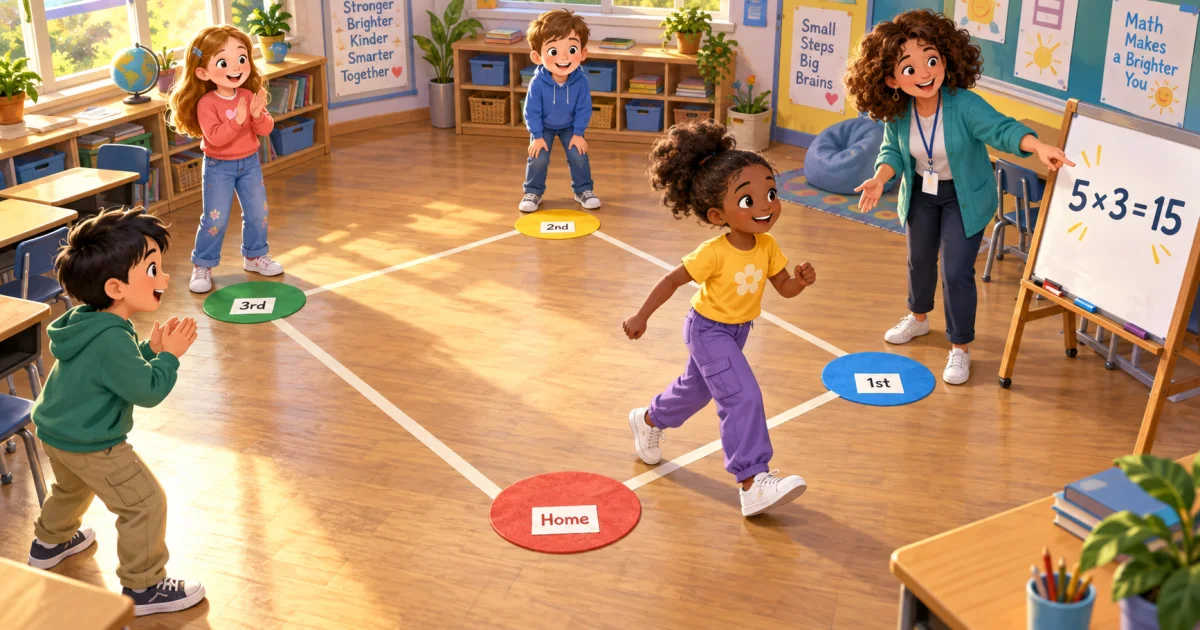
Mark four bases in the room or draw a diamond on the board and split the class into two teams. The "pitcher" (you) calls a fact, and the batter chooses the difficulty before hearing it: a 2s, 5s or 10s fact is a single, a 3s or 4s fact a double, a 6s to 9s fact a triple, and an 11s or 12s fact a home run. A correct answer moves runners around; a wrong one is an out. Three outs and the teams swap.
Letting batters choose the difficulty means confident children take risks while hesitant ones can still score with safer singles.
3. Multiplication Jeopardy
Draw a grid on the board with categories across the top ("3 times table", "Square numbers", "Missing factor", "Story problems") and point values down the side. Teams take turns choosing a square and answering. A correct answer earns the points; a wrong answer simply passes the turn, so nobody loses points for trying.
4. Multiplication Bingo
Each child has a card of products. You call the fact, not the answer ("seven times eight"), and children cover 56 if they have it. Bingo suits a full class because everyone works on every call, and luck gives every child a real chance to win. Ask the winner to read back their line and the facts behind it. Our multiplication bingo guide explains how to build cards with a good spread of products.
5. Relay Race
Teams line up facing the board. The first child walks (or runs, if space allows) to the board, solves one problem, comes back and tags the next teammate. The movement is welcome after long seated work, and every team member has to contribute. See the relay race guide for setups that work in a small classroom.
Math Center Games
Center games need simple rules, cheap materials and a way to check answers without you. A multiplication chart at each table solves the last point: children check a disputed answer instead of calling you over. You can print one from our multiplication charts page.
6. Multiplication War
Two players split a deck with the face cards removed. Each turns over two cards and multiplies them; the larger product takes all four cards. Remove high cards for beginners, or count jacks and queens as 11 and 12 for a full 1–12 workout. The multiplication war guide has more variations.
7. Memory Match
Make pairs of cards, one with a fact (6 × 8) and one with its product (48), and lay them face down. Players turn over two cards and keep them if they match. Use one table per set at first, then mix tables. Our memory game article shows how to make the cards in minutes.
8. Multiplication Dominoes
Each tile has a product on one end and a different fact on the other. Players join a fact to its product, so children must read the chain both ways: "which fact gives 24?" and "what is 3 × 8?". Keep one set for the 2s to 5s and another for the 6s to 12s, each in a labeled bag.
9. Dice Games
Two dice and a scoresheet are enough for a whole family of games: roll and multiply, highest product wins the round, or first to reach 100 points. Ten-sided dice extend the practice beyond 6 × 6. Our ten dice game variations are ready to print as center cards.
10. Race to 100 Board Game
Draw a simple track of 100 squares. Players roll two dice, multiply, and may move forward only if they answer correctly; the product decides how far, so a reference chart is useful. Add a few "bonus" and "go back" squares for suspense. For more ideas, see multiplication board games.
Five-Minute Games for Warm-Ups and Transitions
11. Lightning Round
Call facts quickly while children write answers on mini whiteboards, then everyone shows their boards together. On days with devices, a one-minute speed test does the same job and gives each child a score to beat next time. From our page for teachers you can copy a link that opens the test on the table of the week, ready to start.
12. Hot Potato
Children pass a soft ball while music plays. When the music stops, you call a fact and the child holding the ball answers, with help from neighbors if needed. Count the class total of correct answers rather than singling anyone out.
13. Sparkle
Children stand in a circle. You call a fact, and children say the digits of the answer one at a time around the circle: for 6 × 8, one says "4", the next "8", the next "sparkle", and the child after that sits down. For a kinder version, play cooperatively and see how many facts the class can complete without a mistake.
14. Stand Up, Sit Down
Call a fact and give a rule: stand if the product is even, sit if it is odd. Change the rule each round: stand for products over 50, for multiples of 10, or for square numbers. Children must find the product and then think about it, which builds number sense as well as recall.
Managing Games in a Busy Classroom
- Teach the routine first. Play a new game once with easy facts so the rules, voice level and clean-up are clear before the content gets hard.
- Agree on a quiet signal. A raised hand or a light switch brings the noise down without shouting.
- Prepare materials in advance. Card sets in labeled bags and a chart on every table stop games from stalling.
- Make everyone answer. In team games, each member must answer before the team can finish; rotate who leads.
- Offer a private option. Anxious children can write their answer on a whiteboard for you to check instead of calling it out, and still earn the point for their team.
- Celebrate effort. Praise improvement, helpful teammates and good sportsmanship, not only the winners.
Using Games to Assess
Keep a class list on a clipboard during games and mark the facts that make children pause. After a week a pattern appears: perhaps most of the class is secure with the 2s, 5s and 10s but slow on 6 × 7, 7 × 8 and 8 × 6. Those facts become your next mini-lessons and the focus of the next game. Our article on the hardest times tables lists the usual suspects and strategies for each.
Now and then, ask a child who answered correctly how they knew. "I just know it" shows automatic recall; "7 × 7 is 49, plus 7" shows a sound strategy that is not yet automatic. Both are fine, and the difference tells you what kind of practice comes next.
Frequently Asked Questions
A short game every day works well as a warm-up or transition, with a longer game two or three times a week during practice time. Keep games alongside teaching, independent practice and problem solving rather than in place of them.
Choose games with some luck (bingo, dice games), use team formats, and celebrate personal bests instead of only winners. A child who beats their own speed test score from last week has a real success to be proud of.
Ask the occasional player to explain an answer, and keep the stakes low so there is little reason to bluff. Games are for practice; for grades, use individual written work.
No. Games build fluency once children understand what multiplication means. Teach the idea with equal groups and arrays first, then use games to make the facts automatic.
Ready for Your Next Lesson
Print charts and tables for your game centers, and copy a speed test link for the table of the week so the class can start with one click.