Multiplication Relay Race: Group Activity Ideas
How to run a multiplication relay race in class or at home: setup, rules, variations for every level and tips to keep it fair and inclusive.
Print, check and practice
Start with a worksheet and its answer key, or follow the five-day pack. Both are free and available in Letter and A4.
Multiplication relay races transform times table practice into energetic team competitions that get students moving while building math fluency. These kinesthetic activities combine physical movement with mental calculation, engaging students who struggle to focus during sedentary seat work. The team structure creates positive peer pressure and shared accountability that motivates effort while reducing individual performance anxiety compared to solo activities.
What You'll Learn
- How to organize effective multiplication relay races in classrooms
- Multiple relay race variations for different spaces and group sizes
- Equipment needs and setup procedures
- Adaptations for diverse learners and ability levels
- Assessment strategies within competitive relay formats
Why Relay Races Work for Multiplication Learning
Movement gives children who find it hard to sit still a reason to focus, and the burst of activity between answers keeps the whole class alert. Every turn is still a fact recalled, so the practice is real even though it feels like a game.
Team structures distribute mathematical challenge across multiple students. Struggling learners contribute alongside strong students, with team success depending on collective rather than individual performance. This interdependence reduces the isolation and anxiety some students feel during independent work while creating natural peer tutoring opportunities.
The competitive element motivates focused effort and rapid calculation. Students concentrate intensely trying to help their teams win, pushing toward faster more accurate recall than they might demonstrate during low-stakes individual practice. This productive pressure builds fluency effectively when balanced against excessive anxiety.
The energizing format provides brain breaks during extended academic periods. After long stretches of seated instruction or independent work, relay races restore alertness and engagement through movement and excitement. Strategic placement of relay activities optimizes attention throughout full instructional blocks.
Basic Multiplication Relay Race Format
Setup and Organization
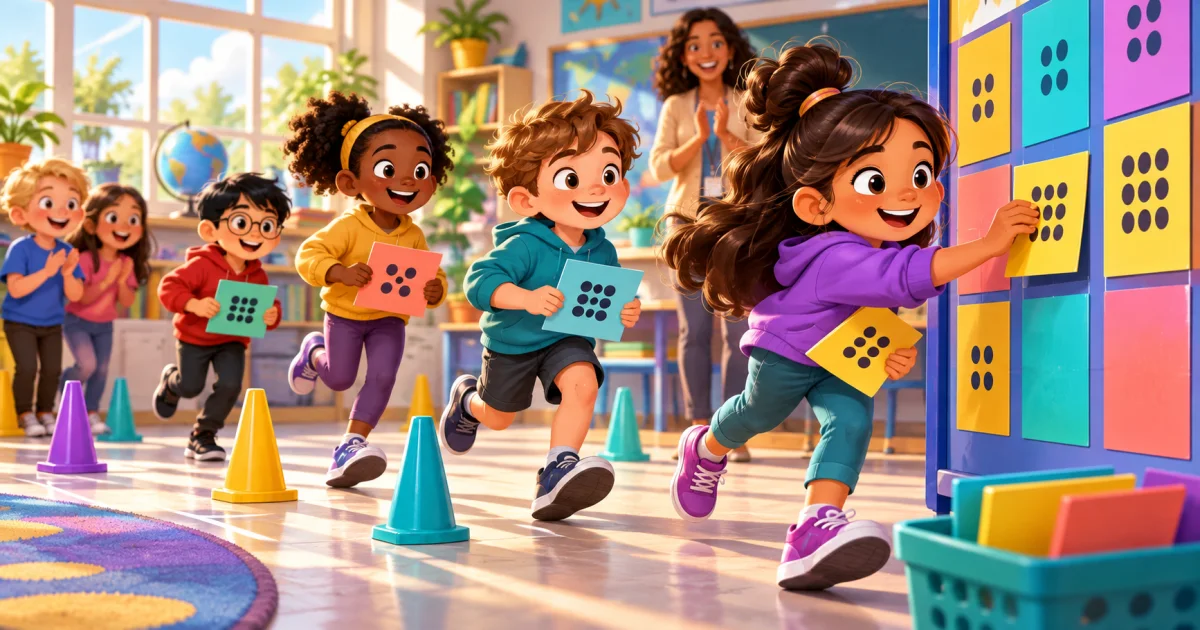
Divide the class into equal teams of four to six students each. Teams line up single-file at one side of the playing space facing a board, wall, or designated answer station at the opposite side. Provide each team identical sets of multiplication problems, markers or chalk, and answer recording materials.
The first student from each team races to the answer station, solves one multiplication problem, records their answer, then races back to tag the next teammate. That second student solves the next problem and returns to tag the third, continuing until all team members have completed one or more problems depending on problem set size.
The first team finishing all problems correctly wins. Incorrect answers must be corrected before teams can claim victory, often requiring final runners to fix teammates' mistakes before finishing. This correction requirement maintains mathematical accuracy standards within the competitive format.
Clear boundaries and safety rules prevent injuries during excited competitive movement. Establish walking zones near answer stations preventing collisions, designate specific paths for running to avoid mid-race crashes, and set zero-tolerance policies for pushing or shoving. Safety protocols enable energetic competition without dangerous chaos.
Problem Sets and Difficulty
Create equivalent problem sets ensuring fair competition. Each team should receive problems of similar difficulty in identical quantities. If one team's problems include primarily easy 2 and 5 table facts while another's feature difficult 7 and 8 table facts, unfair advantage undermines the relay's motivational purpose.
Mix problem difficulties within each set providing success opportunities for varied ability levels within teams. Include some easy facts allowing struggling students to contribute successfully alongside harder problems challenging advanced students. This range ensures all team members can participate meaningfully.
Adjust problem quantity based on available time and class size. A team of five students might handle 10-15 problems in a 10-minute relay, averaging two to three problems per student. Longer relays risk losing attention while very brief activities may not provide sufficient practice justifying setup time.
Display problems prominently at answer stations using large clear fonts. Students should read problems easily from approach distances without squinting or confusion. Unclear problem presentation causes frustration unrelated to mathematical ability, undermining the activity's educational value.
Relay Race Variations
Board Racing Relay
Students race to a whiteboard or chalkboard where problems are written. Each student solves one problem, records the answer below it, then races back. This classic format works excellently in classrooms with accessible board space.
Advantages: Permanent problem display allows students seeing which problems remain before their turns, potentially preparing mentally. The public visibility also enables teacher monitoring of student work processes and common errors.
Adaptations: Use different colored markers per team allowing easy identification of each team's answers. Or have students erase problems after answering, removing visual scaffolds and increasing memory demands.
Card Stack Relay
Create stacks of index cards with one multiplication problem per card. Cards stay face-down at a central station. Students race to the station, flip a card, solve the problem mentally, call out the answer to a teacher judge who confirms correctness, then race back.
Advantages: No writing materials required. The verbal answer format accommodates students with writing difficulties. Immediate teacher verification prevents accumulating unchecked errors.
Adaptations: Require students to state complete multiplication sentences ("Six times seven equals forty-two") rather than just products, reinforcing problem-answer connections. Or have students write answers on mini whiteboards for verification before calling out.
Obstacle Course Multiplication
Students navigate simple obstacle courses (weaving through cones, crawling under tables, jumping over lines) before reaching answer stations. This added physical challenge increases kinesthetic engagement while building gross motor skills alongside mathematics.
Advantages: The increased physical demand benefits highly energetic students who need substantial movement to maintain focus. The novelty factor increases engagement beyond standard racing.
Adaptations: Adjust obstacle difficulty matching students' physical abilities. Students with mobility limitations might have shorter paths or different obstacles ensuring fair participation. Focus competition on mathematical accuracy rather than physical speed.
Multiplication Scavenger Hunt Relay
Hide multiplication problem cards throughout the classroom or outdoor area. Team members search for cards, solve found problems, then bring cards and answers to a verification station before their next teammate searches. First team collecting and solving all their team's cards wins.
Advantages: The searching element adds problem-solving and spatial reasoning to mathematical practice. The distributed problem locations prevent bottleneck congestion at single answer stations.
Adaptations: Use color-coded cards so each team searches only for their assigned color. Or provide clues about problem locations requiring additional cognitive work beyond simple searching.
Silent Speed Multiplication
Students complete traditional relay races but must remain completely silent throughout. Any team speaking louder than whispers receives time penalties. This variation develops self-regulation and teamwork without verbal communication.
Advantages: Significantly reduces the noise levels that sometimes make relay races disruptive to neighboring classrooms. Forces students to use non-verbal communication developing alternative interaction skills.
Adaptations: Allow specific hand signals or gestures for communication. Or require teams strategizing silently before races about optimal runner order and approaches.
Cumulative Product Relay
For older students (fourth grade and up), each student multiplies their rolled or drawn number by the previous student's product instead of solving a separate problem. The first student might calculate 3 × 4 = 12, the second then calculates 12 × 5 = 60, the third calculates 60 × 2 = 120, creating exponentially growing products.
Advantages: Practices multi-digit multiplication alongside basic facts. Develops number sense about how products grow rapidly through repeated multiplication. Creates dramatic tension as products become increasingly large.
Adaptations: Allow calculator use for verification after mental calculation attempts. Or limit dice to smaller numbers preventing products from exceeding manageable calculation ranges for elementary students.
Classroom Management Strategies
Team Formation
Thoughtfully construct heterogeneous teams including varied ability levels within each group. Homogeneous grouping where strong students team together often leads to consistent winners and losers across multiple relays, demoralizing weaker teams. Mixed-ability teams level the playing field through combined strengths.
Rotate team composition regularly preventing cliques and ensuring all students work with diverse classmates. Weekly or unit-based team changes provide stability for short periods while maintaining novelty and preventing unfair advantage from particularly synergistic combinations.
Allow occasional student choice in team formation alongside teacher-assigned groupings. The autonomy increases buy-in though requires monitoring to prevent exclusive friend groups or intentional ability-based sorting. Perhaps monthly "choice days" balance teacher structure with student agency.
Assign team roles beyond just running and solving. Designate captains coordinating strategy, timekeepers monitoring pace, encouragers providing positive support, and reporters explaining team strategies afterward. These varied roles ensure all students contribute meaningfully regardless of mathematical or athletic ability.
Maintaining Appropriate Competition
Frame relay races as challenges improving on class previous records rather than defeating other teams exclusively. This collaborative competition reduces between-team hostility while maintaining the motivational benefits of competitive goals. Teams work toward shared class objectives even while competing in the moment.
Celebrate effort, improvement, and sportsmanship alongside victory. Recognition for most-improved teams, best teamwork, or excellent mathematical explanations ensures success definitions extend beyond merely finishing first. This multi-dimensional achievement maintains motivation across diverse students.
Address unsportsmanlike behavior immediately and firmly. Gloating, put-downs, or poor losing responses undermine the positive learning community relay races should foster. Clear expectations and swift consistent consequences for violations maintain healthy competitive environments.
Debrief after relay races discussing what went well and what teams might improve next time. These reflective conversations develop metacognitive awareness about effective teamwork and problem-solving strategies. The discussions extend learning beyond the immediate activity into transferable skills.
Safety Protocols
Establish clear running paths preventing collisions. Mark lanes with tape or cones creating designated routes each team follows. The physical boundaries prevent the chaotic criss-crossing that risks injuries when multiple excited students run simultaneously.
Require walking within specified proximity zones around answer stations. The final approach and initial departure from crowded areas must occur at controlled walking speeds preventing collisions near concentrated groups.
Remove tripping hazards from the racing area. Backpacks, chairs, and other obstacles create unnecessary injury risks. A few minutes of classroom reorganization before relay races prevents the accidents that could occur in cluttered spaces.
Position adult supervisors strategically throughout the space. Teachers cannot monitor all students from single positions during distributed relay activities. Multiple adults observing different zones ensures comprehensive safety oversight and fair rule enforcement.
Adaptations for Diverse Learners
Supporting Struggling Students
Allow multiplication chart references for students with memory challenges. The goal is building confidence and comfortable participation, not testing current recall under pressure. Chart use during relay races provides scaffolding while students continue developing automatic recall through other practice methods.
Assign struggling students first or last positions in team lineups. First position ensures their contribution happens while problems are easiest or energy highest. Last position allows learning from observing teammates' approaches before their turns while sometimes requiring only one problem if time runs short.
Provide individual problem sets where all teams' problems aren't identical. Struggling students might solve easier facts while advanced peers tackle harder combinations. This differentiation occurs subtly through problem distribution rather than obvious separate activity announcements that could embarrass students.
Pair struggling students with peer buddies who can provide quick hints or encouragement during races. The support maintains participation without removing all challenge or making relay race performance solely dependent on helper rather than learner effort.
Challenging Advanced Students
Assign advanced students more problems per turn or harder problem selections. Rather than solving single problems, strong students might solve two or three before returning. This increased load maintains appropriate challenge without slowing overall team pace.
Require advanced students explaining their mental calculation processes to teammates after races. This verbal articulation develops metacognitive awareness while providing peer teaching opportunities benefiting entire teams. The explanation expectation adds cognitive demand beyond simple calculation.
Include extension challenges where advanced students attempt optional bonus problems earning extra team points. These optional extras allow showcasing abilities without disadvantaging teams lacking advanced students. The voluntary nature maintains inclusion while recognizing high achievement.
Use multi-digit multiplication or multi-step problems for advanced student turns. Products requiring regrouping or problems like "5 × 6 + 7" add complexity maintaining engagement for students who find basic facts too easy.
Using Relay Races for Assessment
Observational Assessment
Circulate during relay races observing which students answer quickly and confidently versus those who hesitate, count on fingers, or require peer assistance. These informal observations reveal fluency levels and specific fact gaps informing future instruction.
Note problem-solving strategies students employ. Some might skip count, others use doubling strategies, while some recall automatically. Understanding their approaches helps teachers provide strategy instruction addressing individual patterns.
Document team dynamics and mathematical communication. Observe whether teams support struggling members constructively or express frustration. These social behaviors inform character education needs alongside mathematical instruction.
Record specific facts repeatedly causing difficulty across multiple students. If numerous students struggle with 7 × 8 or 6 × 9 during relay races, these facts need additional whole-class instruction or focused practice time.
Formal Data Collection
Use recording sheets tracking individual student accuracy and speed during relay races. While maintaining competitive excitement, systematic data collection transforms games into assessment opportunities documenting progress toward fluency standards.
Compare relay race performance to other assessment data. Students performing well during relay races but poorly on written tests may have test anxiety. Conversely, students succeeding on tests but struggling during relay races might have attention or processing speed challenges. The comparison reveals complete learner profiles.
Related: multiplication board games
Related: multiplication games for kids
Frequently Asked Questions
Ten to fifteen minutes provides substantial practice and competition without excessive time consumption or exhaustion. This duration includes setup, racing, and brief debriefing. Longer relay races risk losing attention and becoming counterproductive.
Yes, with modifications. Use desk-to-desk movement instead of across-room racing. Or conduct hallway relay races during passing periods when corridors are empty. Even seated relay races where students pass problem stacks around their team circles can work in very constrained spaces.
Implement silent relay race variations or schedule relay races during times when noise proves less disruptive (perhaps when neighbors have P.E., music, or outdoor classes). Alternatively, take relay races outdoors when weather permits.
Primarily use teacher-created heterogeneous teams ensuring balanced competition and diverse interaction. Occasionally allow student choice as special treats maintaining motivation. The balance provides structure while honoring student preferences periodically.
Emphasize team performance over individual contributions. Frame activities as "whole class against our previous record" minimizing between-team competition. Offer alternative roles for students uncomfortable with racing, like timekeepers or answer checkers.
Summary
Multiplication relay races combine physical movement with mathematical practice creating engaging kinesthetic learning experiences. Teams race to solve multiplication problems with the first finishing accurately declared winners. This format benefits energetic students needing movement, creates team accountability distributing performance pressure, and provides motivating competitive elements driving focused effort.
Multiple variations including board racing, card stacks, obstacle courses, scavenger hunts, silent speed races, and cumulative product formats accommodate different spaces, equipment, and instructional goals. Effective implementation requires thoughtful team formation, appropriate competition framing, clear safety protocols, and adaptations supporting diverse learners from struggling students needing scaffolds to advanced learners requiring additional challenge.
Strategic use as observational assessment tools provides informal data about fluency levels, problem-solving strategies, and social-mathematical behaviors. When implemented thoughtfully within balanced comprehensive mathematics programs, multiplication relay races provide valuable practice building both computational fluency and collaborative skills essential for academic success.