Multiplication Activities from Kindergarten to 5th Grade
Multiplication activities for every grade from kindergarten to 5th: early grouping and skip counting, arrays, fact practice games and multi-digit problems.
Print, check and practice
Start with a worksheet and its answer key, or follow the five-day pack. Both are free and available in Letter and A4.
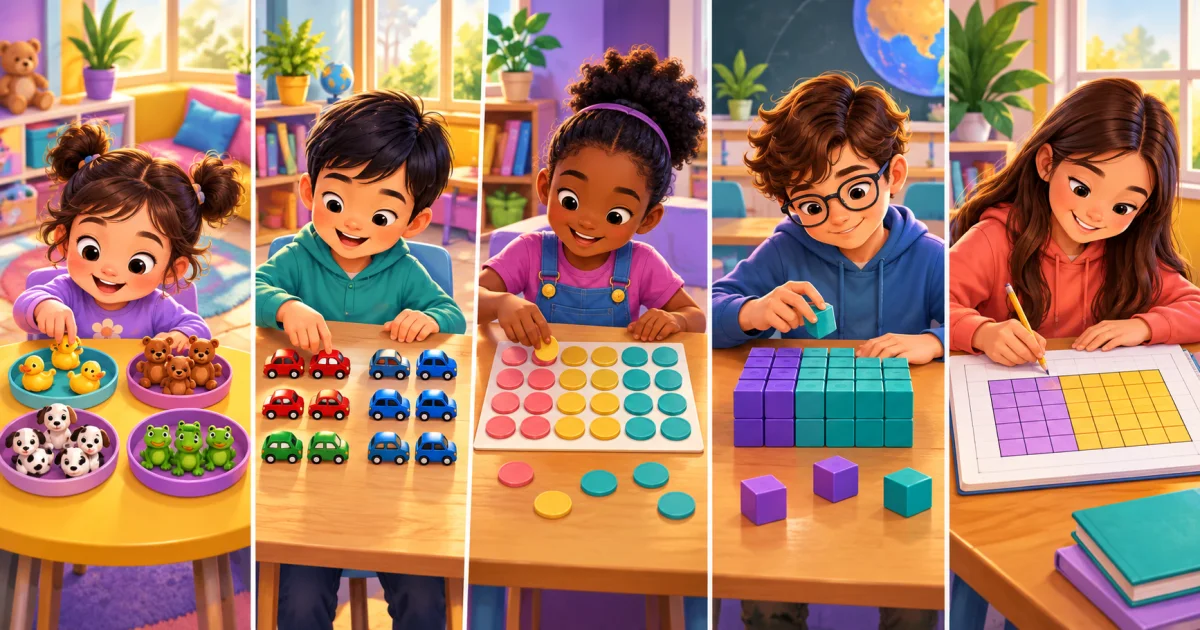
Elementary multiplication instruction spans from kindergarten's earliest foundational experiences through fifth grade's sophisticated multi-digit computation and problem-solving applications. Effective activities progress systematically across grade levels building from concrete conceptual understanding through strategic calculation toward automatic fluency while maintaining engagement through developmentally appropriate hands-on, visual, and interactive formats. This guide gives grade-by-grade activity ideas, from informal grouping games in kindergarten to fractions and decimals in fifth grade.
What You'll Learn
- Grade-by-grade multiplication activity progressions from K-5
- Activities building conceptual understanding, strategies, and fluency
- Hands-on, visual, and kinesthetic activity options
- Differentiation strategies accommodating diverse elementary learners
- Implementation guidance for classroom and home settings
Kindergarten and First Grade: Foundational Experiences
Why Start Early
While formal multiplication instruction typically begins in second or third grade, kindergarten and first-grade activities establish essential foundations. Early experiences with equal groups, patterns, and repeated addition create conceptual scaffolding supporting later formal multiplication learning.
Young children encounter multiplication naturally through everyday situations. Counting wheels on vehicles (4 wheels per car, how many on 3 cars?), sharing snacks equally, or organizing classroom materials into groups present authentic early multiplication contexts. Capitalizing on these natural opportunities builds mathematical awareness long before formal instruction.
Early number skills are among the strongest predictors of later mathematics achievement, and informal play with grouping, skip counting and arrays is an easy way to build them long before multiplication is taught formally.
Appropriate K-1 Activities
Equal Groups Play: During centers or free play, encourage children creating equal groups with manipulatives. "Make 3 towers with 4 blocks each" introduces multiplication structure through purposeful play. The hands-on construction makes abstract concepts concrete and accessible.
Photograph children's creations documenting mathematical thinking. Display photos with captions like "3 groups of 4 blocks = 12 blocks total" connecting physical experiences to mathematical language. These visual records build vocabulary and conceptual connections.
Skip Counting Songs and Chants: Rhythmic skip counting by twos, fives, and tens develops pattern recognition and number sequence familiarity. Melody, rhythm and movement make the sequences easier to remember and build foundations for later times table learning.
Use number lines or hundreds charts while skip counting highlighting visual patterns. Every second number when counting by twos, every fifth when counting by fives creates obvious visual sequences supporting understanding beyond pure auditory memorization.
Story Books with Multiplication: Read age-appropriate books featuring multiplication concepts. "Two of Everything" by Lily Toy Hong, "One Hundred Hungry Ants" by Elinor J. Pinczes, or "The Doorbell Rang" by Pat Hutchins embed mathematics in engaging narratives making abstract ideas concrete and memorable.
Discuss mathematical elements during and after reading. "How many ants are in each row? How many rows? How many ants altogether?" develops mathematical questioning and reasoning within safe familiar story contexts.
Array Recognition: Point out rectangular arrays in classroom and environment. Floor tiles, egg cartons, muffin tins, windows, and bookshelves all feature array structures. Counting objects in arrays (3 rows of 4 means 12 total) builds visual multiplication understanding without formal symbols.
Second Grade: Conceptual Development
Understanding Multiplication Meaning
Second grade focuses on building solid conceptual understanding of what multiplication represents through varied models and contexts. While memorization proves premature for most second graders, deep conceptual understanding established now supports all later learning.
Equal Groups with Manipulatives: Provide extensive opportunities creating, counting, and describing equal groups using physical objects. "Show me 4 groups with 3 counters in each group. How many total?" builds fundamental multiplication understanding through hands-on exploration.
Vary group sizes and quantities ensuring comprehensive experience. Sometimes use small numbers (2 groups of 3) while other times larger quantities (5 groups of 6) within reasonable second-grade ranges. The variety prevents narrow pattern-based thinking building flexible understanding.
Array Building Activities: Square tiles, graph paper, or linking cubes enable constructing rectangular arrays representing multiplication. Students build arrays matching specifications then count total squares discovering products through concrete construction.
Connect arrays to real-world contexts. "A classroom has 5 rows of desks with 4 desks per row. How many total desks?" links abstract arrays to familiar environments. The authentic connections make mathematics purposeful rather than arbitrary.
Repeated Addition Connection: Explicitly teach multiplication as shorthand for repeated addition. Writing 4 + 4 + 4 + 4 + 4 then translating to 5 × 4 shows mathematical equivalence while leveraging known addition skills accessing new multiplication learning.
However, balance repeated addition with other models. Overreliance creates students who always calculate through addition rather than developing efficient multiplicative thinking. Use repeated addition as a bridge, not permanent destination.
Beginning Practice Activities
Skip Counting Practice: Systematic skip counting develops fluency with number sequences underlying times tables. Daily brief practice (3-5 minutes) counting by twos, fives, and tens builds automaticity supporting later fact learning.
Add clapping, stepping or arm movements. Moving to the rhythm keeps young children engaged and gives the count a steady beat.
Simple Word Problems: Present straightforward multiplication situations in story contexts. "Each of 3 bags has 5 apples. How many apples total?" develops problem recognition skills identifying when multiplication applies versus other operations.
Include manipulatives or drawing materials allowing students modeling problems concretely. The visual-spatial representations support problem comprehension while building connections between concrete, pictorial, and abstract representations.
Beginning Fact Introduction: Capable second graders ready for additional challenge can begin learning foundational times tables (0, 1, 2, 5, 10). These accessible facts build early confidence and success creating positive multiplication attitudes.
However, avoid pressuring all second graders toward fact memorization. Developmental readiness varies substantially. Focus primarily on understanding with memorization as optional enrichment for ready students rather than universal expectation.
Third Grade: Building Fluency
Comprehensive Third-Grade Activities
Third grade is the intensive multiplication year, when the goal is quick recall of all the single-digit facts. Activities balance conceptual reinforcement, strategic instruction, and extensive practice building fluent recall.
Multiplication War Card Game: Using standard playing cards with face cards removed, players flip two cards each, multiply numbers, and highest product wins all cards. This simple game provides extensive practice disguised as entertainment children play voluntarily.
Create variations maintaining novelty. Perhaps allow "war" when products tie requiring additional card flips. Or play team versions where partners collaborate. The variations prevent boredom while maintaining mathematical engagement.
Multiplication Bingo: Create or download bingo cards featuring multiplication products. Call out problems (not products) requiring students calculating before marking boards. The familiar game structure requires minimal explanation while providing substantial practice.
Vary by using different calling formats. Sometimes state problems verbally, other times write on boards, occasionally use word problems creating varied challenge. The format changes maintain interest across repeated games.
Times Table Challenges: Implement individual or class challenges tracking mastered tables. Students demonstrate mastery through brief assessments then advance to next tables. Visual progress charts showing achieved tables motivate continued effort.
Celebrate incremental milestones rather than only final mastery. Completing the 5 table deserves recognition even though the journey continues. Regular celebration sustains motivation through months-long learning process.
Factor Pair Hunt: Present products challenging students finding all possible factor pairs. "Find all factor pairs producing 24" requires systematic thinking identifying 1×24, 2×12, 3×8, and 4×6. This inverse problem-solving builds flexible multiplication understanding.
Create recording systems where students systematically document discovered pairs. Organized approaches prevent duplicating work or missing possibilities developing mathematical habits benefiting all future problem-solving.
Multiplication Relay Races: Teams solve problems racing against opponents. The physical movement and competition create high-energy engaging practice. Ensure varied problem difficulty allowing all team members contributing meaningfully.
Monitor that competitive energy remains positive and inclusive. Immediately address any negativity, gloating, or exclusionary behaviors. Healthy competition motivates without damaging classroom community or individual confidence.
Technology Integration
Times Tables Rock Stars: This popular UK platform features rock concert themes where students answer multiplication questions advancing through game levels. The engaging format motivates extensive voluntary practice though requires subscription.
Khan Academy: Free comprehensive platform providing third-grade multiplication instruction including videos, interactive practice, and progress tracking. The adaptive system adjusts difficulty ensuring appropriate challenge for each student.
Multiplication.com: Free website offering numerous multiplication games in varied formats. No registration required enabling immediate access though advertising presence requires supervision.
Balance technology with non-digital activities. Perhaps 20-30 percent technology-based practice within comprehensive programs including manipulatives, paper materials, games, and real-world applications. Variety keeps practice fresh and prevents over-reliance on screens.
Fourth Grade: Extension and Application
Moving Beyond Basic Facts
Fourth grade extends multiplication from single-digit fluency toward multi-digit computation and sophisticated problem-solving. Activities maintain basic fact practice for students still building automaticity while introducing more complex applications.
Multi-Digit Multiplication with Area Models: Represent problems like 23 × 4 as rectangles divided showing (20 × 4) + (3 × 4). The visual model makes place value and distributive property concrete supporting understanding of standard algorithm.
Provide graph paper allowing students coloring arrays representing products. The hands-on spatial work develops conceptual understanding underlying computational procedures. Students see why algorithms work rather than following mysterious steps blindly.
Partial Products Method: Calculate 34 × 6 by multiplying each digit separately (30 × 6 = 180, 4 × 6 = 24) then adding results. This expanded method makes place value thinking explicit supporting understanding.
Create partially completed problems where students fill missing steps. Structured formats scaffold learning while maintaining appropriate challenge. Gradually reduce scaffolding as competence increases.
Complex Word Problems: Multi-step problems requiring multiplication within longer solution chains develop application skills. "The school orders supplies. Each of 28 classrooms needs 15 glue sticks costing $2 each. What's total cost?" integrates multiple operations with realistic contexts.
Teach systematic problem-solving processes including identifying important information, determining needed operations, estimating answers, calculating precisely, and verifying reasonableness. Explicit strategy instruction supports students who understand operations individually but struggle applying appropriately.
Factor and Multiple Investigations: Explore number theory concepts including finding all factors for given numbers, identifying multiples, recognizing primes versus composites, and discovering greatest common factors. These investigations build number sense beyond pure computation.
Enrichment Activities
Prime Factorization Trees: Break numbers into prime factors through systematic tree diagrams. "Find prime factorization of 24" develops analytical thinking and systematic organization skills alongside mathematical content.
Multiplication Patterns: Investigate patterns in multiplication tables discovering relationships like "all products in 5 table end in 0 or 5" or "9 table digit sums equal 9." Pattern exploration builds algebraic thinking and number sense.
Real-World Project: Design projects requiring extensive multiplication. Perhaps plan class parties calculating needed quantities, design gardens determining plant numbers, or analyze sports statistics. Extended authentic applications demonstrate mathematics relevance beyond classroom exercises.
Fifth Grade: Mastery and Sophistication
Advanced Fifth-Grade Activities
Fifth grade consolidates elementary multiplication learning while introducing increasingly sophisticated applications preparing for middle school mathematics.
Decimal Multiplication: Extend whole number fluency to decimal products. Activities exploring how decimal placement affects products build place value understanding. "What happens to product when multiplying by 0.1? By 10? By 100?" develops number sense about magnitude.
Fraction Multiplication: Introduce multiplying fractions using area models representing products visually. While conceptually complex, concrete representations make fraction multiplication accessible when built systematically on solid whole number foundations.
Multi-Digit by Multi-Digit: Three-digit by two-digit and three-digit by three-digit multiplication provides appropriate challenge for capable fifth graders. While computationally demanding, systematic application of learned algorithms produces success.
Algebraic Thinking: Problems using variables develop algebraic reasoning. "If 8 × n = 72, what is n?" or "Find all values of n where 15 × n produces even numbers" builds equation-solving foundations.
Order of Operations: Complex expressions requiring multiplication within longer operation chains develop procedural skill and attention to mathematical conventions. "Calculate 3 + 4 × 5 - 2" emphasizes that multiplication precedes addition requiring careful systematic work.
Cross-Curricular Integration
Science Connections: Calculate areas, volumes, densities, or rates using multiplication. Science provides authentic contexts demonstrating mathematics necessity for understanding natural world.
Social Studies Applications: Analyze population data, calculate historical timelines, or determine geographic scales using multiplication. Cross-curricular connections enrich both mathematics and content learning.
Art and Design: Create tessellations, analyze symmetry, or calculate material quantities for art projects. Mathematical thinking enhances artistic expression while art makes mathematics beautiful and creative.
Differentiation Across Elementary Grades
Supporting Struggling Learners
Extended Concrete Experiences: Some students need prolonged manipulative use beyond typical timelines. Allow continued hands-on work until conceptual understanding solidifies. Better late abstraction than premature confusion.
Simplified Problems: Reduce problem complexity matching current capabilities. While peers tackle three-digit multiplication, struggling students practice two-digit problems addressing same concepts at accessible difficulty.
Intensive Intervention: Small-group or individual instruction targeting specific gaps supplements whole-class teaching. Brief daily intensive sessions (15-20 minutes) provide needed additional support.
Assistive Technology: Calculators or multiplication charts provide access enabling participation in grade-level problem-solving while computational fluency continues developing. Don't exclude students from all mathematics until perfect memorization.
Challenging Advanced Learners
Extended Ranges: Students mastering grade-level content explore beyond including larger numbers, additional operations, or more complex problem structures.
Mathematical Investigations: Open-ended explorations develop deep thinking beyond procedural work. "Investigate relationships between area and perimeter" or "Explore patterns in perfect squares" provide intellectual challenge.
Peer Teaching: Advanced students teaching struggling classmates reinforces understanding while developing communication skills. Structure carefully ensuring mutual benefit without inappropriate burden.
Related: introducing multiplication to second graders
Related: 3rd grade multiplication guide
Related: 4th grade multiplication guide
Frequently Asked Questions
There is no fixed rule, and it depends on your curriculum. Multiplication takes a large share of third-grade math time, a smaller share in second grade, and in fourth and fifth grades it shares time with fractions, decimals and measurement. A few minutes of daily fact practice is worthwhile in every grade from third up.
While engagement matters, not every activity must feel like pure recreation. Balance enjoyable games with purposeful practice building essential skills. Some traditional formats serve valuable purposes within comprehensive programs including varied approaches.
Assess through observation, informal questioning, brief formative assessments, and student work analysis. Look for consistent accuracy, appropriate speed, and conceptual understanding indicators. Readiness varies among students requiring flexible differentiated progression.
Generally no. Students lacking foundational understanding need those early conceptual experiences regardless of age. Modify presentation for age-appropriateness but don't skip essential developmental sequences. Building from solid foundations proves more effective than attempting shortcuts.
Difficult but essential balance. Some flexibility exists within standards regarding pacing and specific activities. Advocate for appropriate timelines while working within constraints. Focus on depth and genuine understanding over superficial coverage of excessive content.
Summary
Effective elementary multiplication activities progress systematically from kindergarten and first-grade foundational experiences through fifth-grade sophisticated applications. Early grades emphasize conceptual development through hands-on manipulatives, visual arrays, and playful exploration establishing understanding supporting later formal learning. Third grade focuses intensive practice building automaticity through games, worksheets, and varied engaging formats while fourth and fifth grades extend toward multi-digit computation and complex problem-solving.
A good activity mix balances hands-on materials, drawings, movement, technology and traditional practice while building skills systematically. Differentiation supports struggling learners through extended concrete time, simplified problems, intensive intervention, and assistive technology while challenging advanced students through extended ranges, mathematical investigations, and peer teaching opportunities.
Implementation across K-5 requires understanding developmental progressions, maintaining appropriate expectations for each grade level, balancing varied activity types, and differentiating for wide readiness ranges within classrooms. Strategic systematic activity use produces optimal outcomes preparing all elementary students for successful middle school mathematics.